
How to Grow Wisteria Without It Overtaking Your Yard
If you’ve ever come across a well-grown wisteria vine, you might remember how breathtaking it was! The lavender-blue flowers cascade from the branches in a spectacular display of beauty, combined with a lovely, sweet fragrance.
Learn how to grow wisteria in your own garden.
How to Keep Wisteria Under Control
Before learning how to grow and care for a wisteria vine, it is important to learn how to control it. Unfortunately, the popular Chinese (Wisteria sinensis) and Japanese wisteria (W. floribunda) can spread aggressively, choking out trees and native plants and causing damage to buildings.
The best option is to choose native varieties that will not become invasive, but if you have a beloved non-native wisteria plant that you can’t bring yourself to part with, careful pruning can keep its growth in check.
Wisteria Vine Pruning Tips
Chinese and Japanese wisteria should be pruned twice per year to keep them from spreading too aggressively. The same techniques may be used on native wisteria to help shape the vines and encourage flowering.
1. Summer Pruning
The first trim should occur after the flowers fade and the new growth begins looking unruly, around early to midsummer. Cut new shoots down to six inches long, and remove any from the main vine that are not necessary. Also, make sure to remove any suckers that have sprouted from the roots.
2. Winter Pruning
A second pruning should take place in late winter, as a wisteria vine will continue to grow after its summer trim and can become a bit unwieldy even over a few months. Plus, the branches are easier to see without their foliage. Cut back lateral branches growing on the main trunk, leaving each with just three to five buds. You can also remove branches that are too crowded or unruly to improve the overall appearance of the wisteria.
How to Contain Wisteria Roots
Because wisteria grows so tall, it also develops long anchoring roots to help stabilize the large plant. These roots can cause damage to buildings and hardscaping, and invasive wisteria especially, can sprout even from a small root fragment. Given this, you will want to consider containing wisteria roots as well as the vines.
Avoid planting wisteria near walls, sidewalks, plumbing, and other structures. Corrugated metal sheeting can act as a barrier and help divert wisteria roots from structures that are too close to the destructive plant. You can even grow wisteria in a container!
If you decide to replace an invasive wisteria vine with a native variety (please do!), take care when removing the old plant. Manually removing every last bit of wisteria root is next to impossible. The best technique is to cut the trunk close to the ground, then carefully apply herbicide directly to the cut surface.
Best Wisteria Plant Varieties to Grow
Because Chinese and Japanese wisteria vines are invasive, native wisteria varieties are best. Look for American wisteria or Kentucky wisteria.
American Wisteria (W. frutescens)
Native to the Southeast, American wisteria climbs up to 30 feet high with proper support and is hardy in USDA zones 5–9. It blooms later in spring than nonnative types but often produces a second crop of lovely flower clusters in mid- to late summer.
The popular ‘Amethyst Falls’ cultivar features large clusters of lavender-blue flowers. Others include the white ‘Nivea’ and deep bluish-purple ‘Longwood Purple.’
Kentucky Wisteria (W. macrostachya)
Even hardier than American wisteria, Kentucky wisteria can survive winters in zone 3. It blooms a bit later, in June, but can flower as many as three times in a single season and has larger flower clusters. With support, Kentucky wisteria reaches 25 feet high.
Try the ‘Blue Moon’ cultivar, which produces long, one-foot flower clusters with a bluish-purple hue and wonderful fragrance.
There are many good wisteria varieties and hybrids
Again, native varieties — American wisteria and Kentucky wisteria — are best, but in case you have your heart set on one of the exotic vines and are willing to dedicate extra time and effort to keep them under control, here is a bit more about those species.
Although Chinese wisteria (W. sinensis) is native to the warmest provinces of China, it is quite hardy and will grow in much cooler climates. It is hardy to -10 to -20 degrees Fahrenheit.
Chinese wisteria has a Japanese relative, Wisteria floribunda. It requires similar conditions, but the flower color is more lavender-purple, and the flower clusters are longer.
Japanese wisteria opens its flowers gradually from the top of the clusters to the bottom, whereas Chinese wisteria opens its flowers nearly all at once. Japanese wisteria also comes in white- and pink-flowered forms, plus the spectacular ‘Longissima’ and ‘Longissima Alba’ varieties, which have incredibly long flower clusters. Given ideal conditions, these clusters can be up to five feet long.
Chinese and Japanese wisteria are invasive if not pruned properly and often. Remember to plant wisteria AWAY from paths and your house foundation. Remove fresh shoots throughout the summer to keep them under control. Or, plant wisteria in a large pot to make it easier.
How to Grow Wisteria
Wisteria thrives in sunny south- or west-facing exposure where it climbs by using its twining shoots. Every spring, it produces cascades of lovely lavender flowers.
One of the loveliest of all the hardy climbing plants, wisteria is also among the earliest to bloom. From the South to the North, cascades of blue flowers begin to appear in early spring to tell us warm weather is on its way.
Wisteria can grow to an enormous size. Left unchecked, it can grow to a height of 15 feet or more.
The compound, pinnate leaves can have nine to 19 leaflets, depending on the species. Wisteria is deciduous, and the leaves appear either at the same time as or just after the flowers. There is often a second flowering in late summer, but it is never as profuse as the first. The older it gets, the better it blooms.
Best Place to Plant Wisteria
Wisteria is most successfully planted in a warm, sheltered spot facing south or west. Although it will tolerate some shade, wisteria produces more and better blooms in full sun.
And remember to keep wisteria away from structures and pipes that its roots might damage.
How to Plant Wisteria
Buy and plant wisteria in the spring or fall.
Wisteria prefers moist, well-drained soil: good, rich garden soil is best. If the soil is hard and clayey, mix in some compost before you plant. Dig a hole deep enough to comfortably fit the root ball and two or three times as wide. Settle the plant into its new home, fill in the hole around it with your rich soil, and water it thoroughly. Adding a good layer of mulch will help suppress weeds and hold in moisture.
For multiple vines – e.g., if you want to create a wisteria tunnel – leave 10 to 15 feet between each plant to allow the extensive roots plenty of room to sprawl.
How to Grow a Wisteria “Tree” (Vine)
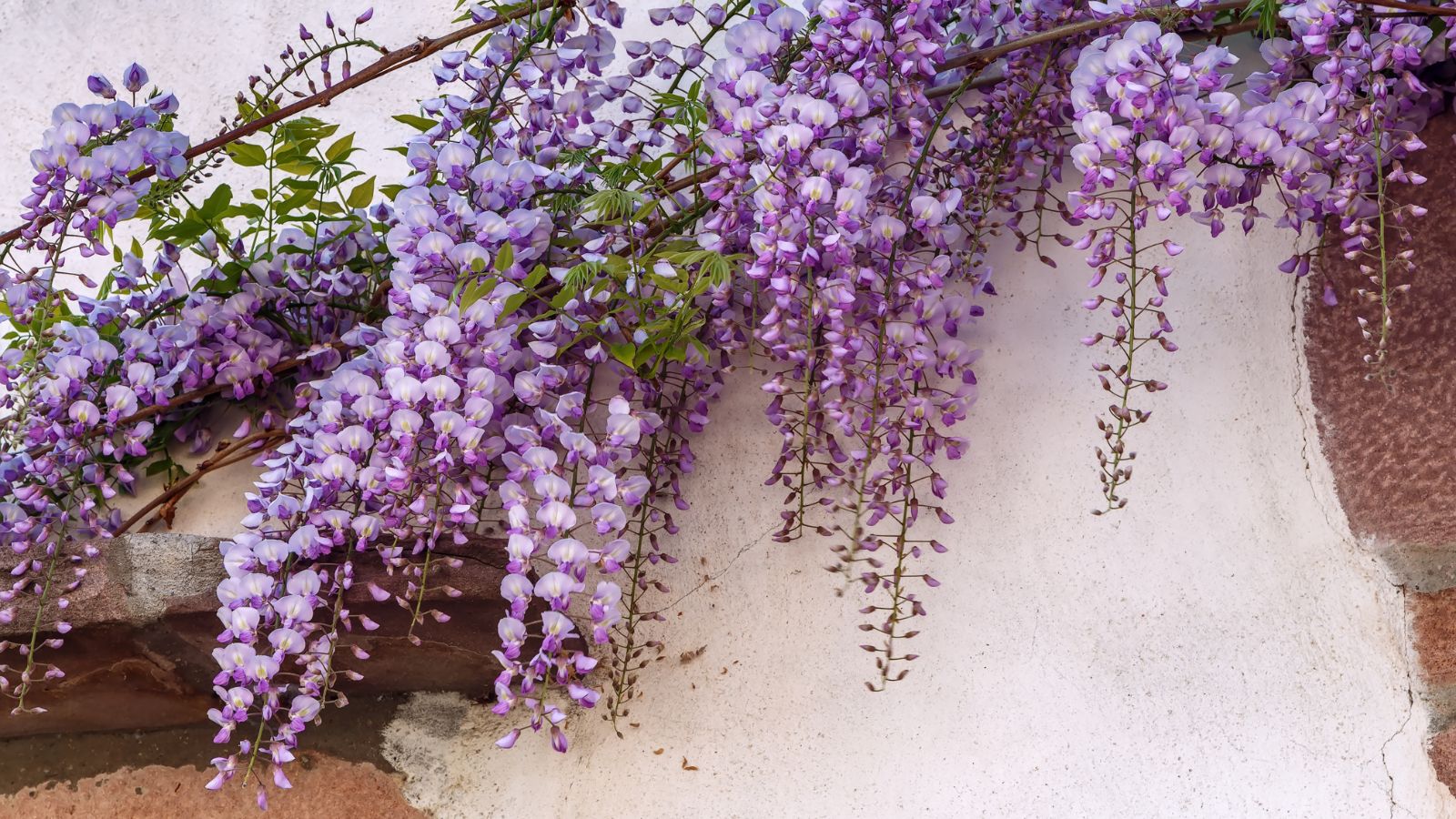
Did you know? Wisteria vines can be trained to grow into a graceful and stately wisteria tree (or rather a vine that looks like a tree)!
At the time of planting, push a wooden stake six to 12 inches in the ground about a half-inch away from the trunk of the wisteria. Using tie tape (or similar), secure the trunk to the stake every eight inches or so, taking care not to restrict trunk expansion. The tie tape will need to be replaced as the wisteria tree/vine grows, and the stake should eventually be swapped out for a larger, sturdier one.
To encourage globe-shaped branches at the top of the trunk, give any unruly branches a light trim as needed throughout the growing season. In late summer, after the flowers fade and before the first frost, the wisteria tree/vine should also receive one hard pruning.
As with all types of wisteria, prune the current year’s growth back to five or six buds per branch, and completely remove any unwanted branches.
How to Grow Wisteria in a Pot
One great way to contain aggressive wisteria is to grow it in a container. Purchase a wisteria plant with just one stem (this will be easier to train), and choose a container slightly larger than the nursery pot the wisteria came in. When you plant the wisteria in its new pot, add a sturdy stake about five to six feet tall and gently tie the trunk to it.
As the wisteria grows, continue tying it to the stake until it reaches the top. Once it outgrows the stake, trim off the top of the wisteria vine to prevent it from growing too tall. Prune new growth in late winter to six to 12 inches — potted wisteria is best grown as a wisteria tree (see the previous section).
Remember that wisteria roots also grow vigorously, so you will need to repot your wisteria as it grows, moving it to a slightly larger pot each time. Because containers dry out faster than the ground, closely monitor moisture levels as well. A general-purpose fertilizer should be applied in spring.
Wisteria’s Special Needs
When buying a wisteria, remember that it can become quite large and needs plenty of room. This goes for the roots, too. They are very long and like to grow deep into the ground. If you plan to grow wisteria in a pot, make sure you use a container as large as possible (check out our large outdoor planters for ideas).
Wisteria care and grooming
Early to midsummer is the time for cutting back wisteria. Use this time to remove unwanted or overly long stems; otherwise, it will develop rampant, tangled growth and few flowers the following year. Cut the side shoots back to about six inches. This will encourage the growth of flowers from the same side shoots the following year.
A second pruning can occur in late winter; see “Wisteria Vine Pruning Tips” above for more details.
Feed with a balanced fertilizer two or three times during the season.
Move the plant only if it’s really necessary, since this will usually set it back a bit. This should only be done toward the end of the winter dormant period.
Young plants may take a few years to settle down and start growing. There is nothing wrong if there aren’t any flowers for the first couple of years.
Watering and feeding
If planted against a warm, sunny wall, wisteria must be watered well. Never let it dry out. Plants that grow on hot walls get reflected heat and lose more moisture through evaporation than other plants in the garden, especially in dry weather.
Less water is needed in winter, but once the flower buds begin to form, regular watering is again needed. Feed with a well-balanced fertilizer up to three times a year.
Propagating wisteria
It is very easy to get wisteria seeds to grow: just soak them overnight and plant them in a seed tray. However, one can never be sure that the resulting plants will flower well. Wisteria grown from seed may never flower, and in most cases, even if it does, it may take years (up to 20) to do so.
A better method is to plant hardwood cuttings in late winter before the flower buds swell, or graft on rootstocks, which can be grown from seed.
Wisteria flowering and fragrance
In a sheltered spot, wisteria can bloom quite early in the spring, but it usually takes three to five years from planting before it reaches mature “flowering age.”
The long, hanging cascades of flowers are mostly in various shades of lavender-blue, but there are also pink and white varieties. The flowers have a lovely, sweet scent.
If you like sweet-smelling flowering vines, you’ll love growing honeysuckle.
Wisteria Vine Problems and FAQs
Why does my wisteria not have flowers?
The flowers may fall off if the weather is too cold and stormy. If your vine didn’t have blooms to begin with, it may be too young or not have ideal growing conditions.
How do I get my wisteria to flower?
It may take years for a wisteria vine to bloom, but the flowers are worth the wait. Most wisterias need to reach a certain age (three to five years or more) before they will bloom. If you’re wondering how to get your wisteria to bloom, flowering can be encouraged by planting wisteria in rich, fertile soil and full sun and pruning the vines in late winter.
Why does my wisteria have yellow leaves?
Yellow leaves and weak growth are probably the result of poor soil. Feed with a balanced fertilizer.
What types of pests attack wisteria?
Aphids and other insects may occasionally visit the wisteria, but rarely, if ever, become a problem.
Why are there black patches on my wisteria leaves?
Fungal diseases are rare on wisteria, but if you see black patches on the leaves, treat the plant with a fungicide.
How fast does wisteria grow?
Chinese and Japanese wisteria grow fast and aggressively. Under the right conditions, some wisteria vines can grow as much as ten feet in a single growing season.
When do you plant wisteria?
It is best to plant wisteria in the spring, though you can also plant it in the fall.
How long does wisteria take to grow?
Wisteria takes several years to mature and begin flowering. The native Kentucky and American wisteria flower in just two to three years, while Chinese and Japanese wisteria can take as long as five years or more. If planted from seed or a cutting, wisteria can take even longer to bloom.
Can you grow wisteria from a cutting?
Yes! Wisteria grown from a cutting will take longer to mature and flower, but it can certainly be done. Plant hardwood cuttings in late summer, before the buds swell, or graft onto rootstock.
What do you do with wisteria in the spring?
Spring is the best time to plant wisteria. It is also a great time to provide fertilizer and resume regular watering.
How long does it take for wisteria to grow from seed?
Wisteria can take up to 20 years to flower when grown from seed if it flowers at all. Cuttings are more reliable for propagation.
Can I prune a wisteria in the spring?
Wisteria should be pruned in summer and late winter. It should not be pruned during the spring flowering season.
Do you deadhead wisteria?
Deadheading wisteria can encourage a second (or even third!) blooming later in the year and prevents the toxic seed heads from forming. Remove flower clusters when they wilt and droop.
Does wisteria need a trellis?
Yes! Wisteria requires some form of support structure, such as a trellis, arbor, pergola, or even just a sturdy stake.
Are you Ready to Plant a Wisteria Vine in Your Garden?
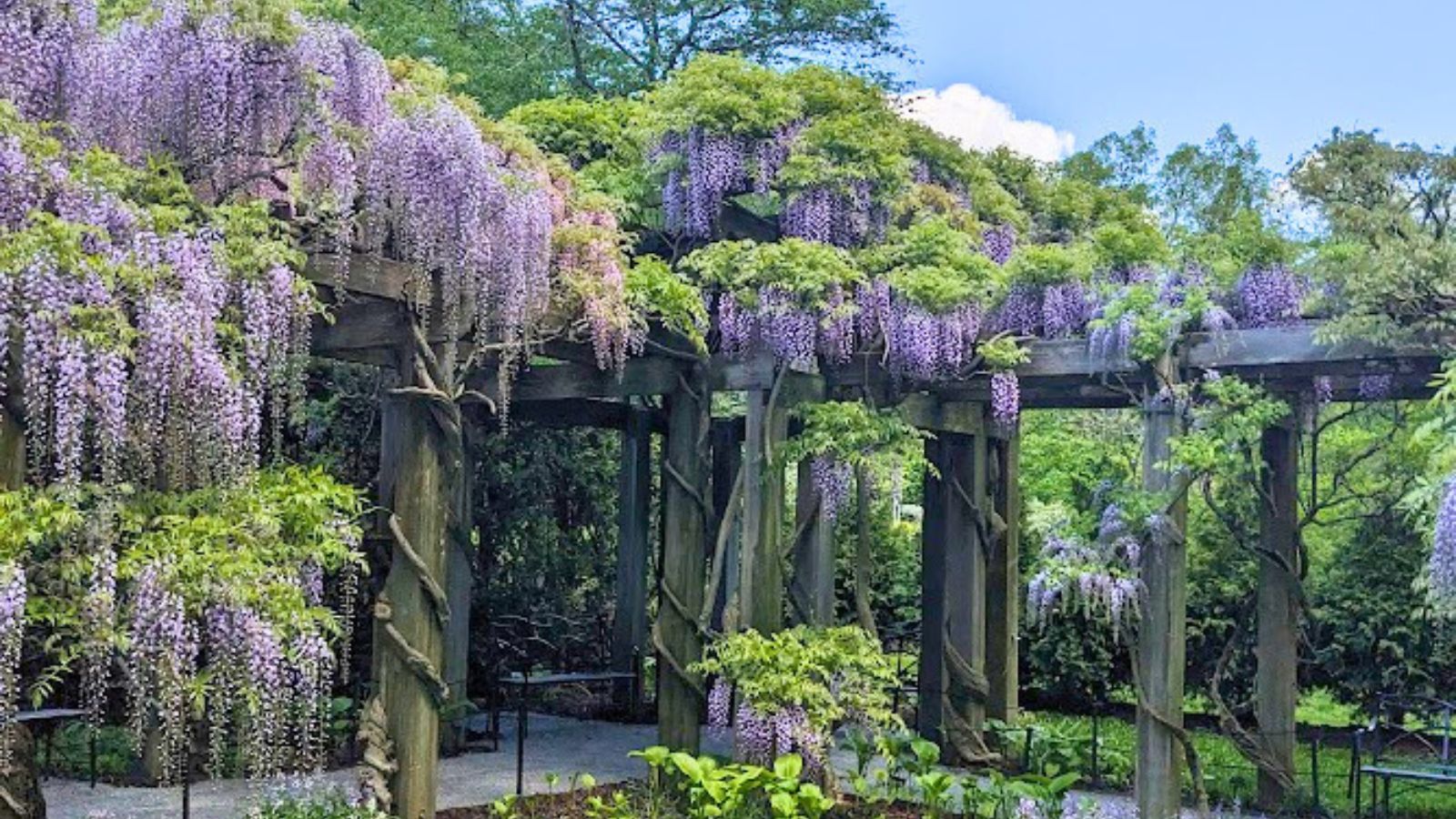
Now that you know how to grow wisteria (and let’s be honest: it’s quite easy), are you ready to plant one in your yard? An excellent climber to grow on a wooden pergola or arbor, the wisteria vine can add real beauty to your front yard.
It can also create the most enchanting quiet spot in your backyard, where you can escape to read a book or just listen to the birds and enjoy a quiet afternoon.
Remember that wisteria can overgrow if not pruned on time. Its roots can also grow quite big, so remember to plant it where it won’t disturb your house foundation or a nice path to your front door.
One last suggestion: since it’s a rather overwhelming plant, give it room and keep it as a solitary plant rather than mix it with other plants.





My mother planted a wisteria start in my yard from her vine 40 years ago. I HATE it!!! In that 40 years I had 1 bloom. I’m talking about “1” bloom. I hate the determination of the vine. I have trimmed it until I was blue-in-the-face & the first thing I knew it was entwined in a tree. I love the beautiful blooms & the gorgeous fragrance but hate the vine. Maybe a wisteria tree.
That’s an old wisteria. there’s a lot that could have happened wrong with it for the last 40 years. If you can, just remove it from your yard and start over with a new one.
My wister is cut it back and new growths too much I have . New growth from a rotten looking stem but still grows new branches. They can be problematic
Can an old vine be dug up and moved in early spring? Will it continue to flower after transplanting?
Wisteria doesn’t like to be moved, but if you must, make sure to get as big of a root ball as you can, and do it in the morning or evening, while it’s a bit cooler.
My brother dug mine up because I was so tired of pruning for no blooms. He got the root ball he said, I even put in behind my shed but the thing came back. Now according to this article its because its with other bushes and facing north.
Is wisteria native only to the US or possible elsewhere I live in Egypt ,so it’s Mediterranean weather ,over here we have bougainvillea vines which flourish vigorously but I’ve always wanted a wisteria do you think it”s possible
I did a bit of Google research and it seems wisteria does well in Cairo. Take a look here: https://books.google.com/books?id=rAZhDozbNdEC&pg=PA119&lpg=PA119&dq=does+wisteria+grow+in+egypt&source=bl&ots=K3VapL8NiM&sig=WJlIiNa0frS9sZdz487G_DnT4HM&hl=en&sa=X&ved=0ahUKEwjpp9HAgrbaAhXHg-AKHY0dARgQ6AEImQEwDw#v=onepage&q=does%20wisteria%20grow%20in%20egypt&f=false
My husband and I moved into his grandmother’s home back in 1991, she had one of these gorgeous plants. She kept it well trimmed in her years with it…fast forward 26+ years. I LOVE the marvelous, huge, fragrant flowers, it is the long roots on top of ground that are my concern. Can I simply cut them off with my shovel? Will this hurt the plant/bush?? Here in NC, the plant has become invasive in wooded areas, along roadside. It grows high as the tallest pine and usually suffocates the tree! So, YES, trimming is a must!!
Yes, it will probbaly hurt the vine, depending on how much you’ll cut. Not sure if it bothers you because it looks bad, or other reasons. If it’s just an esthetic concern, maybe you can build a box/bench around it.
My Westeros quit blooming.Its 18 years old how can I get it to bloom again??
Did you happen to prune it too aggressively? That might be the reason. If so, wait for the next season and see if it blooms again. If not, next year dig a shovel a coupe feet from the plant to cut some of the roots and shock it. It might get it to bloom again.
My wisteria its quite old (possibly 25-30 years old). When I planted it it took years to grow but after the pine tree died and had to be removed it bloomed for 3-4 years heavily then nothing. I trim it and prune it and fertilize it. The trees that shelter it are getting quite large now, could that be the problem? They are close to 25 ft away but South West of it. I don’t want to lose my plant but it’s not a pretty plant any more.
Did you by change over-prune it?
This is the 2nd year after planting my wisteria and it hasn’t grown any twining shoots yet, is this normal and when will it start. it has flowered twice now, but hasn’t grown in size at all.
@Dee, I planted my wisteria 15 years ago. The first year it had very few blossoms (I didn’t trim it). The second year, same. The third through 15th year vines, no blossoms. I hired someone to paint the exterior of my home. He cut this lovely vine covering the back and the side of my home down to a three foot nub (the trunk seriously mangled/chopped, I thought dead). I couldn’t speak and went inside believing I might just strangle him! The next year, WOW! Now I need an iron trellis to let it’s glory shine.
My wisteria destroyed my vinyl trellis – working too much and too little time to notice how it was growing so fast and it twisted the vinnyl till it snapped it – they are very strong plants !
I’m sorry to hear that. Hopefully the beauty it brings to your garden will make up for it 😉
We bought a wisteria tree. It is planted about 8 feet from the back of our house. I trim it in the fall,and it is about 5 feet tall. After reading this I am worried about the roots and our foundation. What does actually happen?
Christine, you are probably safe if you keep on top of it: prune it every year and don’t let it get out of hand. If you feel better, you might want to use an underground barrier to direct the roots away from your house.
I’m wondering if I can train a “summer cascade” wisteria macrostachya “betty Matthews” to be a stand alone tree. I have seen the Asian varieties grow like a tree. If not could I grow it into a mature oak tree? I just don’t want to use a pergola and my ideal spot is in the middle of a field.
Michael, I wish I could help, but I don’t now enough about it to speak intelligently. If you have any nurseries close by, might be worth a chat with them. If not, there are a few online nursery that could help.
Yes! You can! Just remember to Think Bonsai! Lol! In Summer, prune the wild new growth. In Fall, prune side branches as directed within article, back to about 10″. Also, lift in late Winter, every year or two, to shock-prune root ball, to keep it all in check and enjoy a more prolific bloom. Enjoy!
@Allison,
I just grew 2 wisterias from seeds, and bought 2 already grown in pots. I’m planning to bonsai. I cannot grow wisteria on ground because I have a small garden. Thanks for the info.
I planted a wisteria about 7 years ago. I even had a trellis built for it above the gate, so that it could display it beautiful flowers. It never flowered until last year, with one flower, this year it had two! I am so disappointed!
Ive seen that happen with a wisteria down the street the first time i ever saw it bloom it only had a single bloom, this year it it was covered. so every year it blooms it will have more blooms just give it time it should do better every year. Maybe if you add a little bone meal that should give you more blooms. Good luck!
I planted a wisteria about five years ago. It has never bloomed. My husband has trimmed it back a few times. It is healthy and grows good. Please help. I don’t know why it will not bloom. It gets sun and some shade.
I’m sorry to hear that. Some wisterias take a very long time to bloom 🙁
I bought a very small wisteria from a garden centre. It was perhaps 18″ tall. I planted it in my backyard with a metal support. First summer nothing. Second summer maybe 5 blossoms and it had grown to about 3 feet tall. By the third summer, it was over 6 feet tall and cascading over itself. I have100’s of beautiful blossoms over the entire vine. I love it. Every year I trim back the longest of the vines and it just keeps getting better and better.
I have a Wisteria vine. It was planted in a corner and very close to other plants. It strangles all of them. I’d like to move it but I’m afraid to kill it as it’s a beautiful plant. I’m guessing it’s been there for at least 15 years or so(previous home owner planted it). If it can be moved, what time of year should I try to move it? Also it is in the ground, would it be ok if put in a large container?
Could you move the other plants easier? Wisteria doesn’t do well if oyu transplant it: it might stop booming for several years. If you really want to move it, try late fall to early spring, while it’s dormant.
No. Unfortunately it’s planted right in the corner of the yard. So, not only is it strangling my plants near it, but also my neighbors on the other sides of the fence. It’s such a beautiful plant though that I would love to save it and move it if possible.
Is wisteria harmful to cattle?
If they eat enough, yes, it could be harmful.
We bought an old house in Virginia that has 30-year-old wisteria that has destroyed the pergola, ruined the gutters, climbed into the trees, and is just too overwhelming to keep back. Its trunk is at least 8 inches in diameter. I fear that its roots run under the deck and probably under the house. How do I get rid of it for good? One week of lovely blooms isn’t worth the horrors.
Ugh.. I’m sorry to hear that. Yes, while beautiful, wisteria is pretty invasive in some parts of the world. Cut it from the ground, remove all cut limbs and treat with roundup or another strong herbicide. Make sure to gather up all the seed pods too. Hope this works for you.
How deep do the roots go in terms of depth, and could it be compared to an oak in ruining foundation or sidewalks What climbing flowering vine would you suggest next to a bar-enclosed from porch made of concrete. I could also plant along chain link fence. It is south facing. In Houston. Lots of heat and humidity, mild winters. Occasionally a freeze or two.
Leah, I looked up an answer for you form an expert. He says: “The wisteria roots spread so strongly and abundantly that if planted near walls or pavements they can easily grow into them causing serious damage . To prevent this from happening it is advised, whilst planting, to insert a corrugated plastic panel which will force the roots to take other directions, as they are unable to pass through it. Place the plastic panel (at least 2m long) 80cm deep, between the plant and the wall or pavement (or the surface to be protected). In the case of walls and pavements made with cement this problem does not exist.” Read more about wisteria on his site here: http://www.wisteria.it/informa-e.htm
We had wisteria in our yard when we moved in then we had an idea. My husband and I made a beautiful pergola the length of the back yard. Three years later it bloomed. It is gorgeous and is a great screen from the neighbors. My job hobby is trimming it all summer to keep the nice shape
That must be so exciting! I’d LOVE to see pictures when it blooms again this year. If you remember, please stop by and share a picture.
I live in ct. I have had a wisteria for about 15 years or more. It has never bloomed. Not once…my husband every year says he is gonna cut it down. Plenty of leaves. Never any buds. I’m disappointed and disgusted
Kim, some wisteria need 15 to 20 years before they start blooming (if they were planted form seed). Another reason for not blooming could be too aggressive pruning, or if it;s planted in the shade.
i was thinking of getting a wisteria to put on a split rail fence. Would this work?
Karen, it can work, but you’ll need to stay on top of pruning it. If not, it will damage your fence over time.
My wife and I purchased a home in northeast Ohio that was built in 1830….there is a large wisteria planted between the summer kitchen and wrap around porch that faces south but has some protection. We found out from folks that had lived there in the past that the wisteria is very very old. In fact we had a woman in her 80’s stop by just to see the wisteria her grandmother had planted. She said the wisteria was well over 100 years old and she remembered it being full of blooms, which it was doing when she stopped by a few years ago….I’ll never forget the tear running down her cheek while giving a slight smile. She seemed satisfied as she enjoyed precious memories of her childhood! We talked a bit and then she left, and we haven’t heard from her since……the wisteria, it continues to give us beautiful blooms every spring no matter how or when we trim it….
Thanks for sharing Glenn. Please share some of your wisteria pictures on our Facebook when it blooms this spring.
What kind of wisteria grows faster than the other ? In my last house I had two of them outside one of them a Chinese wisteria and the other a Japanese wisteria. One of them grew excessively well and fast and the other one barely grew it all, and we were there 13 years. Just would like to know which one was the fast growing wisteria.
Where I live in SC it is not sold and not recommended as the invasive nature of if damages natural wooded areas.
I’ve had one planted on my chain link fence for almost 20 years – Zone 5 – full sun. It has never bloomed!! I’ve pruned it almost back to the ground at one point and all I get is green plant that overtakes everything. I”m so frustrated!!
Unfortunately, if it hasn’t bloomed so far, it might never bloom. Vines planted form seed do that. I’d just remove it and buy a new one.
I have a wisteria vine right down the road from me that I love passing by and smelling. My question is how possible is it for me to get a start from this vine, and can I start it from a cutting? Or do I need to dig it up with the root on it?
From my content above: “A better way is to plant hardwood cuttings in late winter before the flower buds swell, or graft on root-stocks which can be grown from seed.”
I planted one that I bought from Armstrong nursery. They did not warn me that it was going to take over everything around it. I have to say I hate it too! As some of the other people say. I cannot dig it up because it spread like a cancer. I don’t dare feed it because I would rather kill it. I love beautiful plants and flowers and I love gardening. I had an operation and could not Prune it now it’s crazy. I live in southern California. Do not plant it here unless there’s someone that can constantly watch it.
I am the proud owner of two Wisteria’s. One is over 40 years old, it looked similar in size to the pink photo (tho mine flowers lilac-blue). Last year I cut it back 80% it was too overgrown. My smaller Wisteria is less than 15 years old and blooms nicely though not as profusely as the older one. The latter one is in a garden by itself, the older one shares space with several plants/shrubs & groundcover.
Can the Wysteria plant be used as a ground cover on a bank instead of a climber?
I guess it’s possible, but you’d still have to watch it and prune it so it doesn’t overtake your yard.
I live in Ky and have tied to grow wisteria forever . From your article I’m thinking I’m buying the wrong kind . What should I get for purple flowers fast growing that can tolerate Kentucky.
Try petunias, verbena, salvia: that’s a start.
Hi, I would be interested in your advice. I want to put a pergola 5m by 4m with a wall/foundation on 2 sides, So would you suggest I only plant wisteria in the middle ie. 2m from each wall. If so, will these 2 plants be enough to cover the 5x4m pergola?
Also how many cross bars does it need to stretch over the 5×4? thank you. Diana
Can wisteria be planted close to a tree so it can climb the tree instead of a structure
It will eventually kill the tree. Wisteria is best away from trees, structures, and the house.
I just planted my 2 very 1st wisterias… both were around 1 foot or more and lately their leaves are turning yellow and a little crumpled… our soil is mostly sandy but i put hummus under it… what could have gone wrong? Help please!
Our wisteria was here when we bought the house in 1973. It’s a lot older than that. I have to admit I haven’t been real good about trimming, although I did quite a bit this year of the old, death growth. I believe we have the Japanese relative, Floribunda, long blossom clusters and more of a purplish blue. Ah, smells so nice, lots of blooms. It grows on our 6-foot wood fence. My husband swears it keeps the fence from falling down. I have had no problems with it but it seems to want to grow from east to west.
Can a Wisteria plant be trained to grow up and around a tree trunk? We have a cypress with no branches below about 12 feet, and it’s about 12 feet away from a small stand of trees. It will get ample morning and afternoons sun. They’re a good distance from the house.
Concerns are the deer and small wildlife (owls, birds, rabbits, squirrels), AND the moles that have built a little city under the back yard. My husband will not deal with the moles. The deer ate my tulips and hostas down to the ground. Will they eat Wisteria too?
The deer won’t eat the wisteria: they don’t like its smell. And I guess you can train it up a tree trunk. It might eventually choke out the tree though.
@Sharon, deer will nibble new growth in wisteria
Will the roots of wisteria harm/ destroy I ground swimming pool and pipes??
If the wisteria is close to the pool, sadly, it’s very possible that it will damage it.
We purchased a house in East Texas last year and I discovered this summer that the two tree stumps were wisterias (about 4 inches wide). The previous owner cut down ALL the fruit, nut and flowering trees around the house. Anyway, both stumps have vines coming from them. My neighbor said I could braid the vines together and install some kind of sturdy support for them. And in a few years have a beautiful blooming wisteria tree / vine. Is this true?
Yes, it’s true. After a hard pruning (like yours was, to the ground), it will take a few years for it to bloom again.
How well does wisteria tolerate being drowned on a river bank? I’m looking for something aggressive with a deep root structure, but it must be able to survive underwater for sometimes two or three months.
I wish I could help, but I’m afraid I don’t know if wisteria would be OK under water for that long