
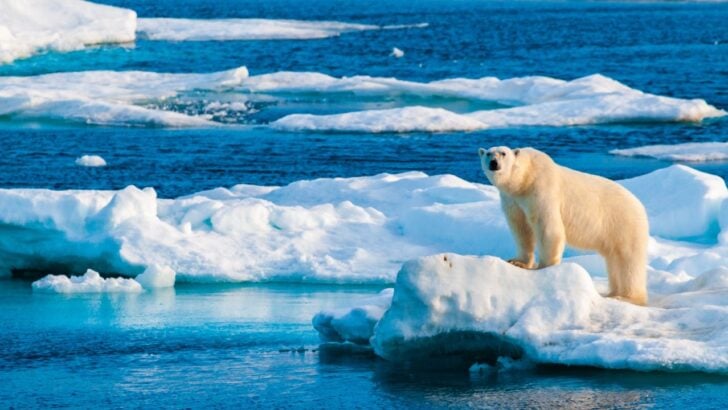
For decades, scientists have compiled a comprehensive annual report that tracks changes across one of the fastest-warming regions on Earth: the Arctic. Now, federal support for that report is coming to an end.
The Trump administration has withdrawn National Oceanic and Atmospheric Administration (NOAA) support for the Arctic Report Card, which NOAA has helped produce annually since 2006. The Guardian reports that the decision was confirmed this week by NOAA communications director Kim Doster.
Doster said NOAA would no longer facilitate coordination of the 2026 report, writes The Guardian. However, she added that data historically supplied by the agency will continue to be collected and made publicly available.
Twila Moon, who serves as an editor of the report, emphasized that the Arctic is a region of interest to the U.S. and not far from the nation’s doorstep. “The US is an Arctic nation,” said Moon, per The Guardian. “It’s not just a distant place. It’s also our national place. So many of the changes there have impacts that reach down into our mid-latitudes, even further south.”
The Arctic Report Card Has A Decades-Long History Of Tracking Changes In The Region
Embedded media follows. Please allow a moment for it to load.
Devastating news for Arctic environmental monitoring today: NOAA pulls support for the Arctic Report Card, effective immediately. #Arctic #Climate
— Rick Thoman (@alaskawx.bsky.social) August 10, 2026 at 4:10 PM
NOAA reports that the 2025 edition of the Arctic Report Card marks 20 years of tracking changes across the arctic. The data is derived from a diverse network of scientific, international, and Indigenous partners. It gathers research on the region’s glaciers, tundra, oceans, and overall ecosystem to compile a comprehensive report.
According to NOAA’s 2025 Arctic Report Card, surface-air temperatures across the Arctic from October 2024 through September 2025 were the warmest recorded since 1900, while Arctic winter sea ice reached its lowest annual maximum in the 47-year satellite record in March 2025.
The report also covers any significant changes on land. In its Arctic Report Card Update for 2025, NOAA wrote that thawing permafrost released iron and other elements into more than 200 Arctic Alaska watersheds, turning rivers that were once clear orange in color. The agency also wrote that the resulting increase in both toxic metals and acidity can damage water quality and aquatic habitats. Scientists are also studying any possible effects on rural drinking water supplies.
Scientists Explore How This Report May Continue
The timing leaves scientists with one pressing consideration: whether this year’s report can still be completed. Eos, the award-winning science magazine that publishes these reports, says that work on the 2026 edition was already underway and had been expected to wrap up within roughly two months when editors learned NOAA was ending its support.
NOAA communications director Kim Doster told the New York Times that “All data historically contributed by NOAA to the product will continue to be collected and will remain publicly available.” Per The Guardian, Doster also said that other NOAA programs would still support research in the region that enables “national security, weather prediction, safety of navigation and the economic vitality of coastal communities.”
Rick Thoman, lead editor of this year’s report, admitted, “We are scrambling to pull the pieces together. I am optimistic that we can find a path forward for 2027 and beyond.”
The hope is that by adapting, the Arcit Report Card can continue to exist and provide valuable insights into changes in the region. “Given the late date, whether we can pull it together for 2026 is an open question, but we’re trying to make it happen,” Thoman added. It remains to be seen what that will look like for the remainder of this year—and for the next 20 years.