NC Museum Visitors Can Watch Scientists Excavate a Dinosaur That’s Never Been Seen
For 75 million years, the remains of a prehistoric creature have been preserved in stone. Now, after making their way to a North Carolina museum, those very remains are about to be uncovered before the public’s eyes. And there’s a chance this dinosaur is one scientists have never seen before.
The creature once roamed what is now southern Utah, with long legs and a toothless beak giving it a striking resemblance to a modern ostrich. Much of its skeleton has remained remarkably intact, offering paleontologists a rare opportunity to learn more about a dinosaur they still know relatively little about.
In an Oct. 23 announcement, the North Carolina Department of Natural and Cultural Resources explained that paleontologists from the North Carolina Museum of Natural Sciences and the Natural History Museum of Utah had excavated the specimen from Grand Staircase-Escalante National Monument.
A Rare Dinosaur With More Secrets to Reveal
Embedded media follows. Please allow a moment for it to load.
View this post on Instagram
Past met present when researchers uncovered a fossilized leg. Upon their discovery, the bones were found to still be arranged much as they had been during the dinosaur’s lifetime. Further excavation revealed additional remains, including the tail, another hind leg, and segments of the neck.
The animal belonged to a group of fast-running dinosaurs called ornithomimids. Scientists estimate that it measured between eight and ten feet long, and its unusually complete skeleton could provide answers that isolated bones alone have been unable to offer: scientists can now study the animal’s overall anatomy rather than trying to piece together its appearance from scattered bones. That, in turn, could help definitively determine if they have indeed discovered a new species.
“This is exactly the kind of fossil paleontologists dream about,” said Lindsay Zanno, the museum’s head of paleontology, in a statement released by the North Carolina Museum of Natural Sciences.
A Labor of Love
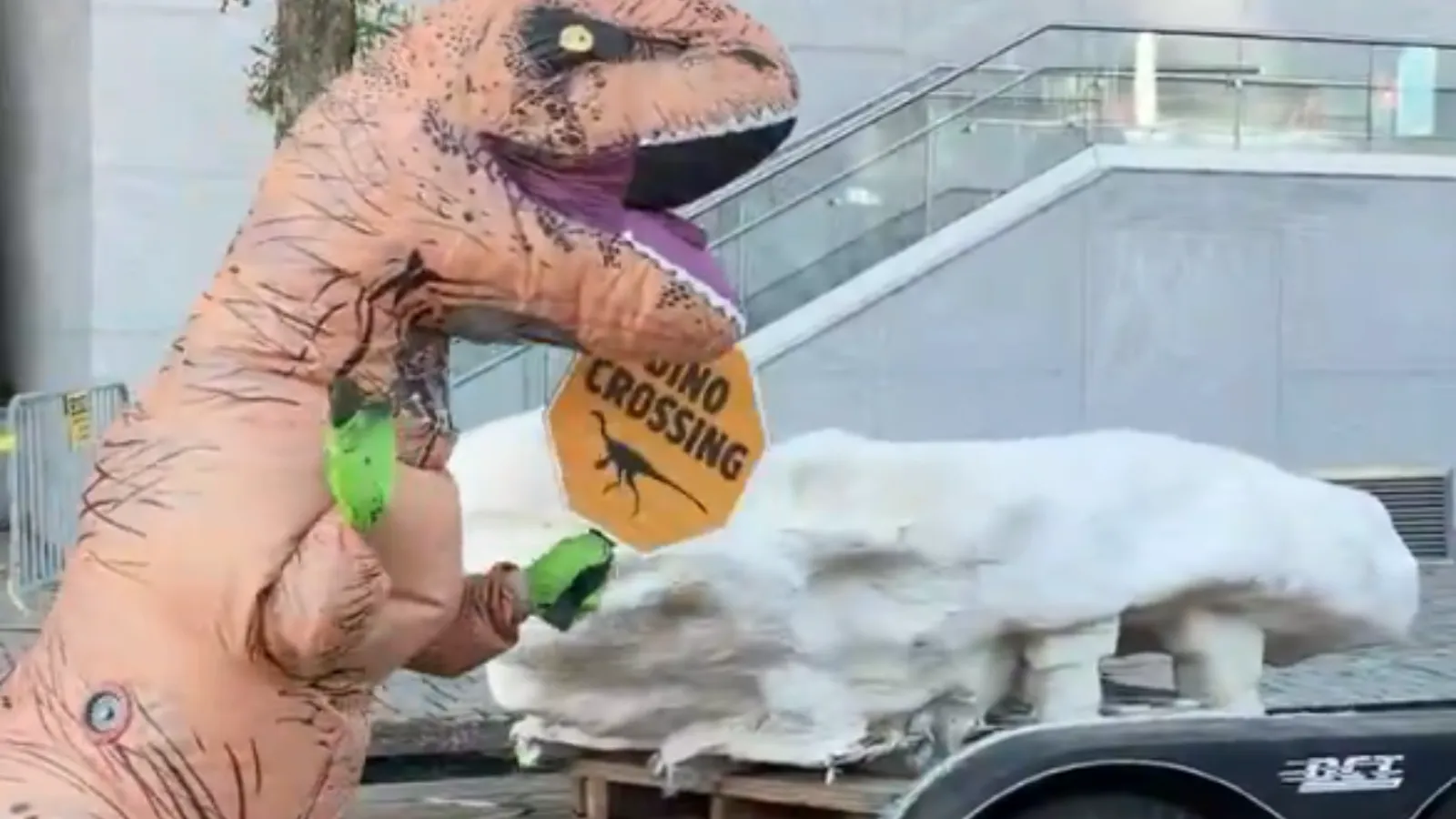
Getting those ancient remains to their new home proved to be a whole elaborate ordeal in its own right. The fossil arrived in downtown Raleigh on Oct. 21 still surrounded by rock and encased in a protective plaster shell of sorts.
All in all, the massive prehistoric package weighed about 5,000 pounds.
The enormous fossil package required a temporary street closure in Raleigh, with heavy equipment lifting it through a window into the museum. All that effort was necessary to keep the ancient remains protected until scientists could begin working through the surrounding stone.
Visitors Get a Front-Row Seat to Discovery
Nowadays, the dinosaur calls the museum’s SECU DinoLab home, and it is there that visitors can watch paleontologists gradually uncover its bones.
There’s quite a bit of work ahead of them, too. Scientists expect the painstaking process of freeing the skeleton from its rocky surroundings could take a couple of years. What they eventually uncover may be significant enough to give this dinosaur a name of its own. Researchers believe the skeleton could become the holotype of a new species, serving as the reference specimen used to formally identify and describe it. That determination, however, will have to wait until more of the fossil has been exposed and examined.
The SECU DinoLab is no stranger to major discoveries. It also houses the museum’s famous Dueling Dinosaurs, which have helped researchers revisit a long-running debate about Nanotyrannus. Research published in 2025 supported the argument that it was a distinct dinosaur species rather than a juvenile Tyrannosaurus rex.
Museum director Denise Young sees an opportunity in letting the public follow the work as it happens. As she explained in the museum‘s announcement, visitors can witness the research long before scientists have all the answers.
And in this case, there’s a particularly intriguing question still hanging over the fossil: just what kind of dinosaur have they brought to Raleigh?