Scientists Harness Underwater Volcano to Generate Electricity in World-First Experiment
Nearly a mile beneath the Pacific Ocean, engineers have managed to accomplish something that feels like it comes straight out of The Jetsons: generating electricity using the intense heat of an active underwater volcano. The breakthrough lasted just 8.7 seconds, yet it marks an encouraging and unprecedented milestone in the search for new sources of renewable energy.
This landmark experiment took place at Axial Seamount, approximately 300 miles off the Oregon coast, where volcanic activity heats water beneath the ocean floor to temperatures exceeding 500 degrees Fahrenheit.
Seattle-based startup Endurance Energy conducted the test on Sept. 27, hoping to demonstrate that a power plant operating on the seafloor could generate more electricity than it needed to run its own equipment.
In an Oct. 19 announcement, Endurance Energy confirmed that its experimental generator had achieved just that. The company hopes the technology could eventually provide a reliable source of renewable electricity for coastal communities, in particular those that currently depend on imported fossil fuels.
Turning Volcanic Heat Into Electricity
Embedded media follows. Please allow a moment for it to load.
Endurance is on a historic run. During our mission to the Axial Seamount, we successfully drilled the world’s first subsea geothermal well and generated net-positive power a mile beneath the Pacific. This mission was the first end-to-end test of subsea geothermal, and our fifth deep-sea deployment in just over a year. For three weeks, we worked around the clock over an active underwater volcano, running the drill and generator and handling every deployment and recovery. Along the way, we:
– Landed our drill within feet of target, drilled two holes, and cased and completed the second as a geothermal well, flowing at 260°C.
– Landed Adélie, our 3-ton test plant, and ran it in real time from Seattle over subsea fiber.
– Drilled with filtered seawater, not drilling mud, and monitored the site on every dive.
– Recovered, serviced, and redeployed Adélie in about 16 hours.
– And on Sept. 27, connected to a 281°C natural vent, spun the turbine up to 26,000 rpm and ran the plant net positive for 8.7 seconds, peaking at 16.5 kW.Net power is the threshold every new energy source has to cross. For Endurance, it proves subsea geothermal is real, and gives us the confidence to keep sprinting towards commercial scale.
With a test like this, success comes from what we learn: a battery protection trip ended the run, a pump cable failed on restart, and the new well was too restrictive to run the plant. Those lessons go straight into Gentoo, our next test plant, this winter and Leopard, our 2 MW commercial generator.
We’re incredibly proud of what we accomplished together. It took creativity, precision, an uncompromising focus on safety from everyone on board, and it’s only the beginning of what we’re capable of. We couldn’t have done it without Stabbert Maritime and the crew of the Ocean Guardian, the ROPOS team, the University of Washington, WASSOC, and the National Science Foundation.
— Endurance Energy (@endurancegeo) October 19, 2026
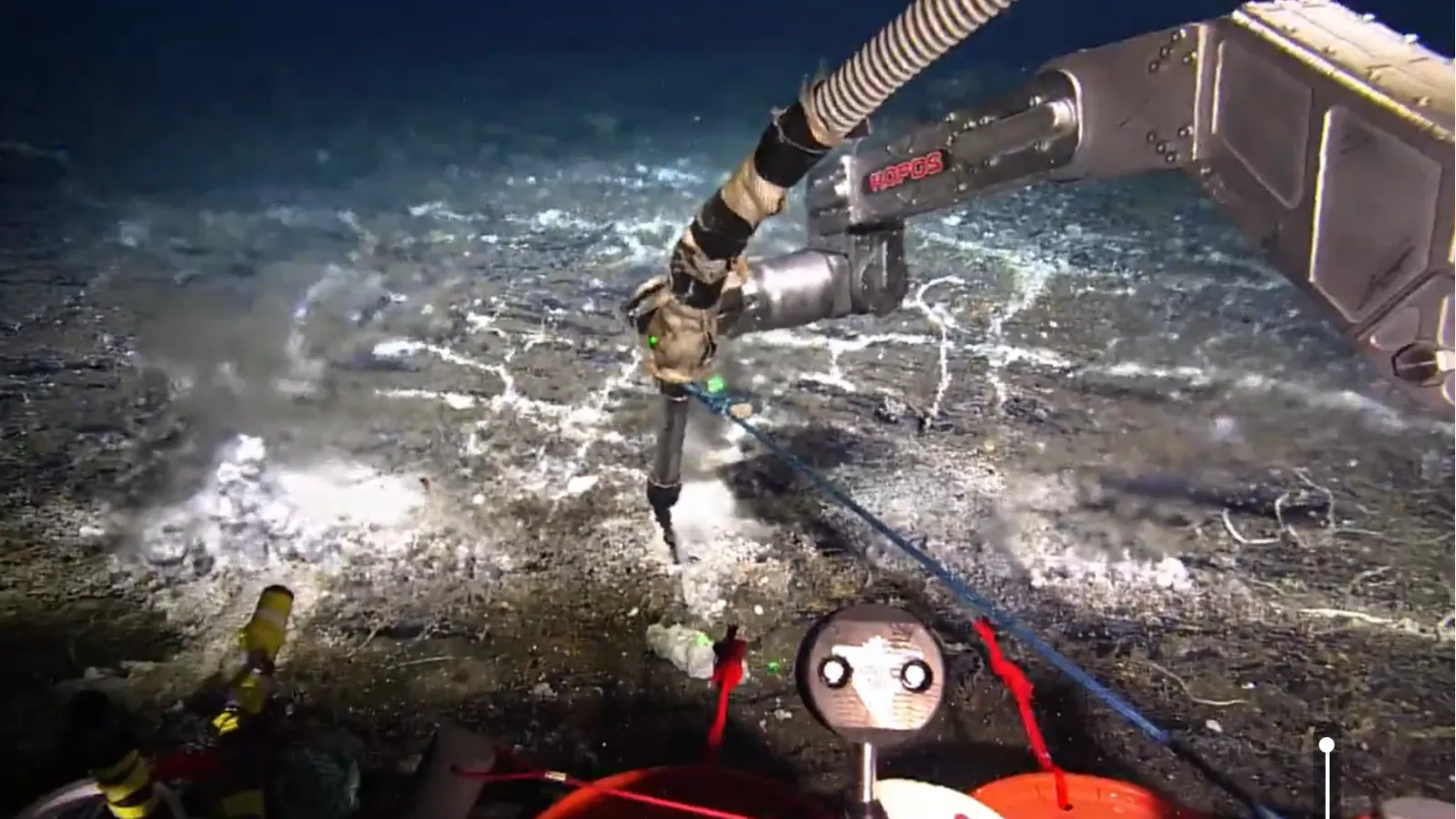
During the three-week expedition, engineers lowered a three-ton power plant named Adélie to the ocean floor. They also drilled a 52-foot-deep well into the seabed, where volcanic activity had heated the water to approximately 500 degrees Fahrenheit.
Unfortunately, the new well was too restrictive to supply the generator with enough hot water. Engineers found another solution nearby, connecting Adélie to a natural hydrothermal vent where water emerged from the seafloor at approximately 538 degrees Fahrenheit.
Once operational, the heated water drove a turbine that reached roughly 26,000 revolutions per minute. According to Endurance Energy, the system briefly produced more electricity than it consumed, averaging about two kilowatts and reaching a peak of 16.5 kilowatts during its successful 8.7-second run.
Helping make the experiment possible was an existing scientific network operated by the University of Washington. Its system of underwater cables continuously transmits information from instruments around Axial Seamount, allowing Endurance engineers to remotely control their equipment from Seattle, hundreds of miles away.
The Next Challenge: Keeping the Power Flowing
This triumphant proof-of-concept also exposed some stubborn engineering problems. A battery protection system interrupted the generator’s operation, and an electrical cable failed during a subsequent restart attempt, ending the trial.
Andrew Redd, founder and CEO of Endurance Energy, told Ars Technica that the demonstration achieved something crucial. “It’s the proof point,” Redd explained. “Net-positive is the threshold that matters: the plant made more power than it took to run itself on the seafloor, which no one had done before.”
Stanford University professor Roland Horne, an independent geothermal energy expert interviewed by the publication, cautioned that operating such equipment underwater comes with a price tag greater than what current operations demand.
“It’s probably technically feasible,” said Horne in an email to Ars Technica, “but it would undoubtedly be more expensive than to do it on land.”
Environmental considerations are another important matter for the team to remain mindful of. Hydrothermal vents support unique marine ecosystems, including tubeworms, crabs, and microorganisms that thrive around the mineral-rich water. Endurance says it selected its drilling location to minimize disturbances and collected more than 40 samples for independent laboratory analysis. The long-term effects of larger operations still require study, however.
Endurance Energy is already preparing for its next underwater trial, with plans to deploy an upgraded generator called Gentoo during the winter of 2026–27. Engineers hope the new equipment will operate for longer periods and produce more electricity. The company also has a commercial project in development in Tonga, where geothermal energy could help reduce dependence on imported diesel fuel. Initial electricity generation is targeted for 2027, although that timeline will depend on how the project progresses.