
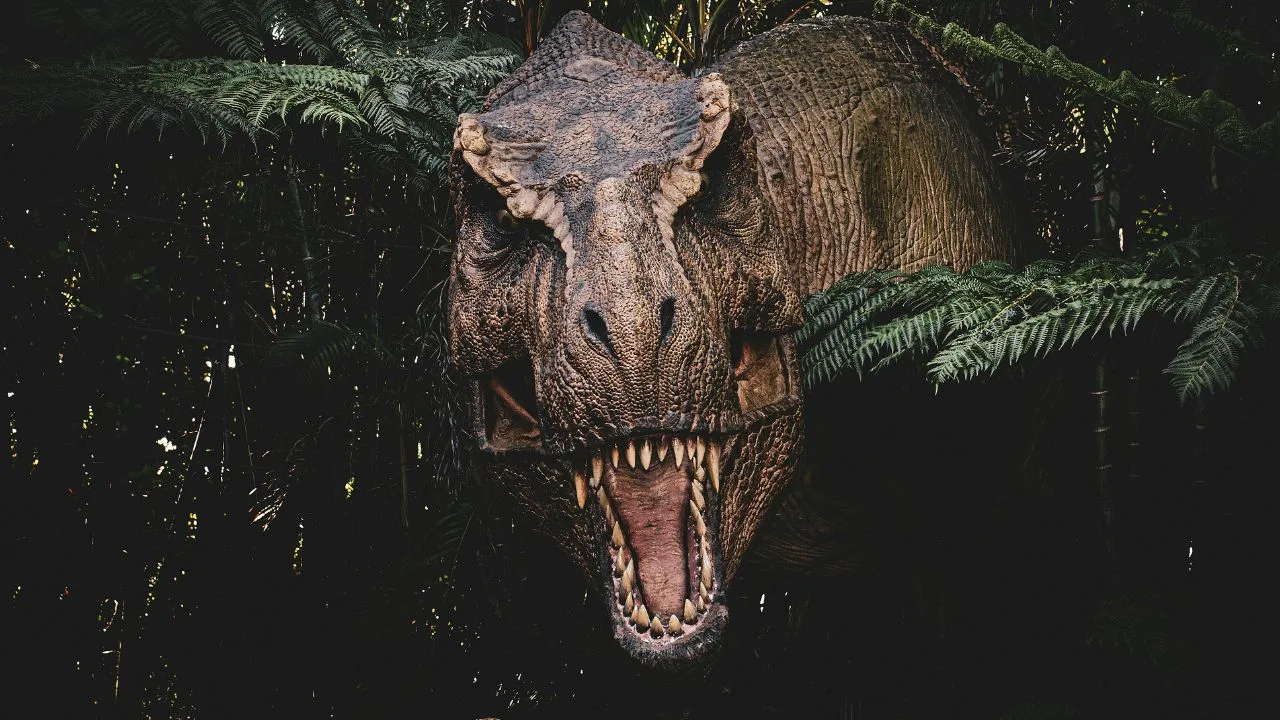
Scientists Discover First Known Adult T. Rex Trackway in North Dakota
A high school teacher recently came across a T. rex footprint while walking through North Dakota. Scientists say the discovery turned out to be the first known trackway likely made by an adult T. rex.
The Denver Museum of Nature & Science says the trackway stretches about 23 feet and includes four three-toed footprints. Each print is roughly 3 feet long and dates to about 66.5 million years ago.
Kent Hups, a science teacher at Northglenn High School in Colorado and longtime museum volunteer, spotted the first footprint in 2025 while helping with a fossil dig near Marmarth, North Dakota. The tracks were found in the Hell Creek Formation on federal land managed by the U.S. Forest Service.
The discovery was described in a study published in the Journal of Vertebrate Paleontology. Researchers say T. rex is the most likely animal that made the tracks because of their huge size, narrow toes, and the number of T. rex fossils previously found in the area.
Scientists Can See How Fast It Was Walking
Embedded media follows. Please allow a moment for it to load.
View this post on Instagram
The four footprints include two left and two right tracks, with about 13 feet between strides. Researchers estimate the dinosaur was walking around 3.5 to 4.5 mph, which the museum compares to a brisk human walking pace.
The tracks are heavily weathered, so the speed is only an estimate, but having several footprints instead of just one gives researchers a rare chance to see how an adult T. rex moved.
Other T. Rex Footprints Have Been Found Before
Scientists have previously identified isolated T. rex tracks in New Mexico and Montana. According to the researchers, no sequence of footprints had previously been described as likely belonging to an adult T. rex.
The team also used high-resolution 3D scanning to record the entire site. Those scans allowed researchers to study the footprints digitally without everyone having to travel to North Dakota.
Three Footprints Are Headed to Denver
Three of the footprints are expected to be removed from the site by helicopter this fall and transported to the Denver Museum of Nature & Science for preparation and more research.
The museum says it plans to share recovery updates with visitors this winter. Researchers also believe more of the trackway could still be buried under the hillside.


