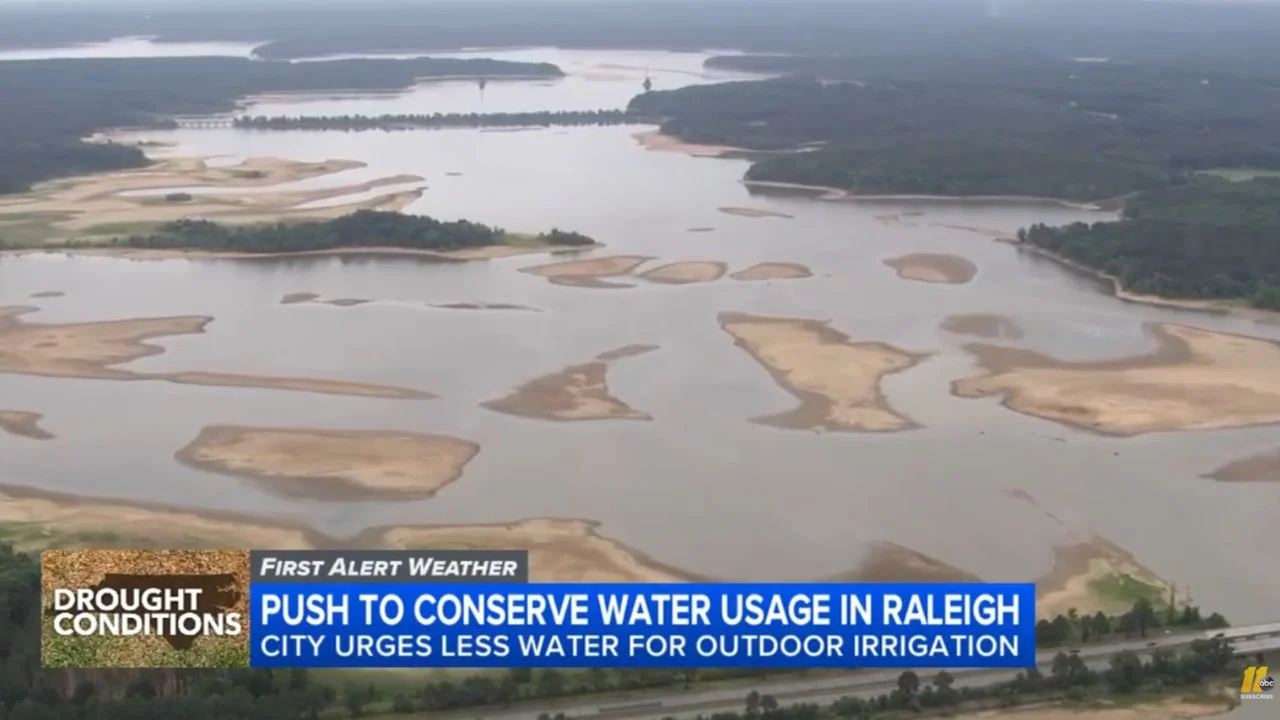
Raleigh Homeowners Face Watering Enforcement As Drought Pushes Demand Higher
Raleigh homeowners with sprinklers still running through the drought are facing more enforcement as water demand climbs across the city’s system.
ABC11 reported that average daily water use has risen to more than 76 million gallons, up more than 10 million gallons from the previous week. Raleigh Water officials tied much of the increase to irrigation as hotter weather dries out lawns, shrubs, and gardens.
The city has had Stage 1 water restrictions in place since April 20, and officials are now expanding enforcement while asking residents to cut back before drought conditions force tougher limits.
The rules do not ban all watering, but they do limit when sprinklers can run, how new landscaping is handled, and how quickly leaks must be fixed after written notice.
Raleigh Water Is Expanding Morning Enforcement
Raleigh Water Assistant Director Ed Buchan told ABC11 that enforcement staff will be out in the morning as the city responds to the demand spike. Since April 20, officials have issued 244 educational letters, 10 official warnings, and recorded 355 violations tied to water-use rules, according to the station.
The enforcement push comes as Falls Lake, Raleigh’s primary water source, continues to drop during the dry stretch. ABC11 reported that the water-supply pool at Falls Lake is at 69% capacity; additional restrictions would be triggered if that level drops to 45%, but city officials said the lake remains above that threshold.
Sprinklers Are Limited to One Assigned Day
Raleigh’s Stage 1 rules limit automatic and manual sprinklers to one assigned day each week. Odd-numbered addresses may use sprinklers on Tuesdays, while even-numbered addresses may use sprinklers on Wednesdays. Those sprinklers may run only between midnight and 10 a.m. on the assigned day, and Raleigh recommends landscape irrigation at a maximum of one-half inch per week during Stage 1.
Hose-end sprinklers follow the same address schedule, but the allowed windows are narrower: 6 a.m. to 10 a.m. or 6 p.m. to 10 p.m. A sprinkler attached to a hose and left on the ground counts as a hose-end sprinkler, not a handheld hose.
Handheld hoses and drip irrigation are still allowed anytime. That gives homeowners a way to target vegetable gardens, flowers, stressed shrubs, and vulnerable plants without running broad sprinkler zones across the whole yard.
New Landscaping and Leaks Have Separate Rules
Raleigh says it is not granting watering exemptions for new landscaping installed after April 20. New sod, shrubs, planting beds, and large lawn renovations may need more water than Stage 1 allows, which is why the city is telling residents to wait on new landscaping projects until restrictions are lifted.
If landscaping was installed before April 20, homeowners may apply for a 10-day variance. The city says special cases will be reviewed individually and may require proof such as a receipt or installation record.
Leaks are covered too. Raleigh says plumbing or service-line leaks must be repaired within 48 hours after written notice, which can include broken outdoor spigots, leaking irrigation heads, underground service-line leaks, and constantly running fixtures.
Warnings Can Turn Into Civil Penalties
The rules apply beyond Raleigh city limits for customers served by Raleigh Water. The city’s conservation measures cover Raleigh Water customers in Raleigh, Garner, Knightdale, Rolesville, Wake Forest, Wendell, and Zebulon.
Properties using irrigation wells are exempt from the current irrigation restrictions because wells are considered non-public water supply systems. Raleigh Water customers using the public system still need to follow the assigned watering schedule.
The city says it is focusing on education first, but residents caught violating the restrictions will receive a warning, and civil penalties can follow after the first infraction. Potential violations can be reported to [email protected].
Homeowners who want to stay inside the rules should check the address schedule, reset automatic timers, keep hose-end sprinklers to the allowed windows, use handheld watering or drip irrigation for targeted plants, and repair leaks quickly after notice.