
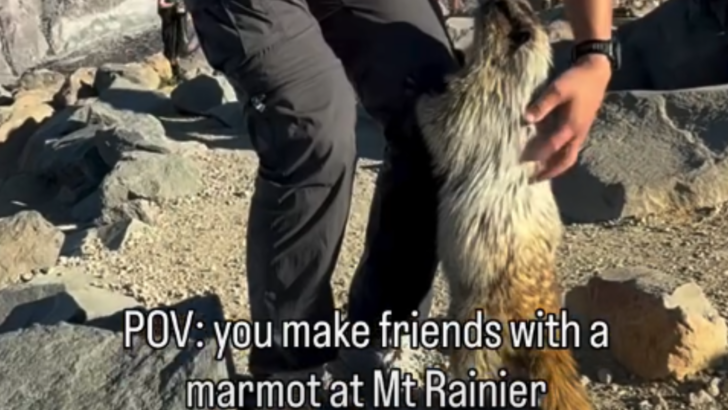
A marmot reportedly approaching during a hike at Mount Rainier National Park seemed like a moment out of a fairytale full of friendly critters. For 23-year-old Jared Shult, scratching the animal on the back ended up dislodging a $230 fine.
The surprises did not run out there, though. Shult says a park ranger tracked him down after seeing the encounter online, called both of his parents, and later posted a copy of his citation on social media.
In an Aug. 28 interview with SFGATE, Shult said he accepts responsibility for touching the animal. “I’m totally fine with being held to that standard and I apologized,” he said, adding, “but did think that the way that it was handled was pretty irresponsible.”
Shult might have been on to something. SFGATE writes that the way this was handled is “not standard procedure.” The park said it was reviewing the matter internally and working directly with the ranger involved.
He Says The marmot approached him first, but touching it was still prohibited
Embedded media follows. Please allow a moment for it to load.
View this post on Instagram
Shult, a Texas content creator, was hiking Mount Rainier’s Skyline Trail in early August when he encountered a marmot and squirrel around a scenic viewpoint. He told SFGATE that he knelt to watch the marmot from a distance before the animal reportedly approached him and pressed against his leg.
Shult scratched the marmot’s back while a friend filmed the interaction. He later shared the video with his Instagram followers, where some viewers quickly pointed out that visitors are not supposed to touch wildlife in national parks.
Federal rules are explicit on that point. Title 36 of the Code of Federal Regulations prohibits feeding, touching, teasing, frightening, or intentionally disturbing wildlife in national parks.
Mount Rainier goes further in its visitor guidance. The park’s wildlife safety page, last updated May 21, tells visitors to remain at least 50 yards (150 feet) from park wildlife and specifically warns against feeding just about every critter, from foxes and birds to marmots and elk. Animals that become accustomed to people can lose natural behaviors and may become aggressive or bite.
He accepted the ticket but questioned the ranger’s approach
After Shult posted his video, the Instagram account @rain_ger_iskander, commented that Mount Rainier rangers would contact him about the misdemeanor.
“I thought it was someone just trolling me,” Shult admitted to SFGATE.
The following day, he said, an unfamiliar Washington number called while he was visiting Portland. When he did not answer, someone identifying himself as a Mount Rainier ranger called each of Shult’s parents and told them their son would be receiving a fine.
Shult eventually spoke with the ranger and received a $230 citation. “I apologized—I totally get it,” he told SFGATE, “They were upset that I posted a video about it for so many people to see. I wasn’t in the right mindset at the time. I saw other people with animals and didn’t stop to think about it.”
He remains less comfortable with the way he was contacted and says he does not know how the ranger obtained his or his parents’ phone numbers. Mount Rainier did not tell SFGATE how that information was found, but confirmed in its Aug. 28 response that it was examining the ranger’s outreach.
SFGATE referenced a Thursday email statement from Terry Wildy, who serves as public affairs officer for the park. According to SFGATE, the email reads, “We are aware of the situation and the concerns raised regarding the outreach methods in this instance. This type of communication is not standard procedure for the park, and we are currently looking into the matter internally and working directly with the individual ranger involved.”
The email continues, “Our primary concern with park visitors approaching, feeding, or touching wildlife—including hoary marmots—is the habituation of wild animals to humans. Habituation can alter natural foraging behaviors, lead to dependency on human food, increase the risk of disease transmission, and result in defensive reactions or bites from animals.”