
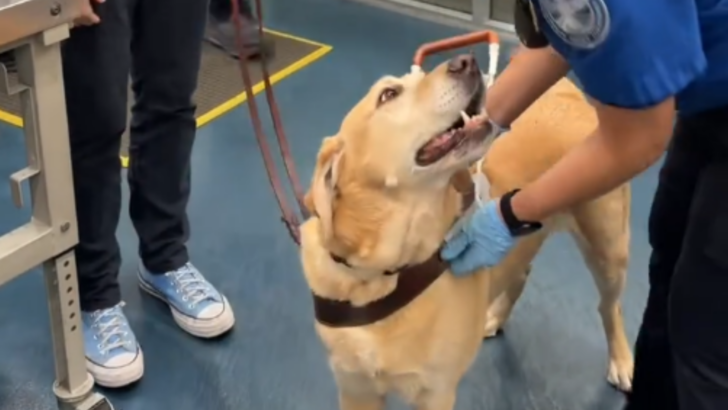
Most travelers would probably describe a TSA pat-down with all sorts of colorful language. Yellow Labrador guide dog Maple, though, seems to be a huge fan. And now, a huge viral celebrity, Maple has something to teach everyone, too.
Footage depicts Maple absolutely basking in the attention as a TSA officer checks his harness at an airport security checkpoint. His handler, artist and children’s author Paul Castle, told PEOPLE the adorable moment ended up driving viewers to ask much bigger questions about the travel experience for someone with vision loss and a guide dog.
Indeed, Castle has said the attention showed him how many travelers had never considered what happens when a working guide dog reaches airport security—and the small but meaningful, empowering steps both TSA officers and fellow travelers can take to make the trip more comfortable for everyone.
Why Mr. Maple Gets His Own TSA Screening
Embedded media follows. Please allow a moment for it to load.
@matthewandpaul Have you ever been seated near a service dog on a plane? ✈️ #dogtok #guidedog #servicedog #travel ♬ Classic classical gymnopedie solo piano(1034554) – Lyrebirds music
The TSA says passengers traveling with service animals are screened using a walk-through metal detector, and additional screening can include a pat-down. Guide Dogs for the Blind warns that metal in a guide dog’s harness, leash, or collar can trigger the detector and lead to further screening.
That is what happens with Maple. Castle has explained that he walks through the detector first and then calls Maple through; metal in the dog’s harness triggers the alarm, leading an officer to inspect him. For Castle, his vision loss creates uncertainty, as he cannot see how officers handle the guide dog that helps him navigate the world; that is a pressing concern for him.
The officer in the viral clip handled that particularly well, according to Castle. The officer narrated what he was doing, told Castle before reaching for Maple’s leash, and explained when the dog would be returned to him.
Clear Communication Can Make A Big Difference
Castle has lost more than 95% of his vision to retinitis pigmentosa, a rare genetic eye disorder that slowly breaks down cells in the retina, which is vital to capturing incoming light. Castle was matched with Maple through Guide Dogs for the Blind in 2021. The pair completed two weeks of training together before returning home to Seattle.
Castle praised the officer’s approach, particularly his willingness to explain each step before taking it. “For airport and airline staff: narrate what you’re doing. That’s it. That’s the whole thing,” he said, as reported by PEOPLE. “You don’t need a certification or a special program — you need to say, ‘I’m going to reach for his leash now,’ instead of just reaching.”
He has advice for fellow passengers, too: enjoy seeing the guide dog, but do not distract him while he is working. Castle explained that when Maple’s attention is pulled away from his job, the consequences can fall on the person depending on him for safe navigation.
Traveling with a service dog also requires planning before reaching security. Castle prepares Maple’s food and water schedule and locates animal-relief areas along the route, while federal rules allow airlines to require a Department of Transportation form attesting to a service animal’s health, behavior, and training.
Still, Castle does not want those logistics to keep guide dog handlers from traveling. As he told PEOPLE, the preparation is real, but it should be treated as preparation—not a barrier to going places