
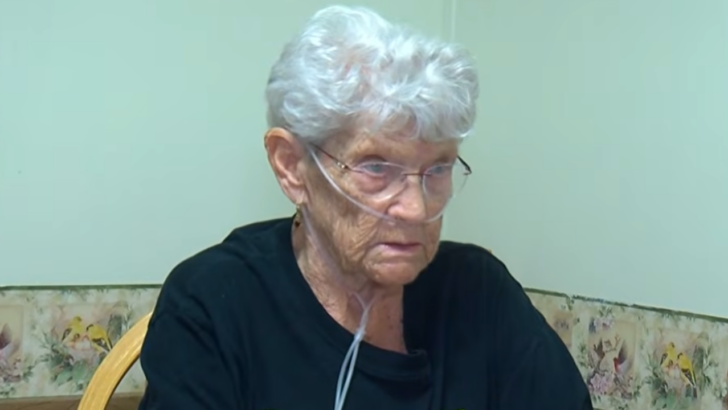
Priscilla Slack is approaching her 85th birthday, which apparently has not stopped various computer systems from getting a little ahead of themselves.
The Wesley Chapel, Florida, woman says she has spent more than two years dealing with the fallout from being incorrectly listed as dead after her husband actually died.
Her bank account and credit card were canceled. She says she discovered she had been removed from the voting rolls when she went to vote. Government benefits have been interrupted.
And just when Slack thought she had finally convinced everyone that reports of her death had been greatly exaggerated, the IRS came knocking.
Still Very Much Alive
Slack told WFLA’s Shannon Behnken that the trouble began after her husband died about two years ago.
Social Security had mistakenly recorded Slack herself as deceased.
At first, she managed to keep a sense of humor about the mistake.
“I kept my sense of humor about it early on, because we can all make mistakes and push the wrong button,” Slack told the station.
Then the consequences started piling up.
Slack said her bank account and credit card were canceled. When she later went to vote, she discovered she had been canceled there, too.
She eventually got the problem corrected with the Social Security Administration, according to WFLA.
That should have been the end of it.
It wasn’t.
Now The IRS Thinks She’s Dead
Slack’s latest problem arrived courtesy of the IRS.
She received a notice saying a tax return had been filed using a Social Security number belonging to someone who died.
There was one obvious problem with that.
The Social Security number was hers.
The IRS really does send notices like this. Its guidance for a CP01H notice says the agency locks an account and refuses to process a return when its information indicates that a Social Security number belongs to somebody who died before the tax year involved.
The IRS then tells taxpayers with a correct Social Security number to contact Social Security and get its records fixed.
For Slack, that creates a particularly frustrating loop because she says she already did.
“How am I supposed to deal with these agencies who can’t deal with each other?” she asked WFLA.
Behnken contacted the IRS, and a spokesman told her the agency was escalating Slack’s case to an advocacy department for resolution.
She’s Not The Only One
As ridiculous as Slack’s situation sounds, mistakenly killing living people on paper is a documented Social Security problem.
And there happens to be some unusually fresh data on it.
The Social Security Administration’s inspector general reported in July that the agency added about 5.6 million death records to its Death Master File during 2025.
It later determined that 12,504 of them were wrong.
That works out to about 0.22 percent — a tiny percentage until you happen to be one of the 12,504 people who suddenly have to convince banks and government agencies that you’re still breathing.
The audit said incorrect death records can result from something as simple as an employee entering the wrong Social Security number or beneficiary code. Bad information can also come into Social Security from relatives, representatives, other government agencies or financial institutions.
There was another finding that sounds particularly familiar after hearing Slack’s story.
Auditors looked at a sample of people who had incorrectly been recorded as dead and later had the death removed from their records. In 45 percent of the cases reviewed, Social Security employees had not properly documented why the person was initially recorded as dead or why the death entry was removed.
The inspector general warned that poor documentation can make it harder for the agency to respond when another problem later appears on the person’s record.
Slack, meanwhile, would presumably prefer to stop serving as the practical demonstration.
People Had Some Ideas
Viewers watching Slack’s story were sympathetic, although quite a few also spotted some potential advantages to being officially deceased.
“What if she starts robbing banks?” one commenter joked. “They can’t charge her? She’s dead.”
Another wondered whether Slack should simply stop paying taxes, reasoning that the government “always seems to find everyone who skips.”
Someone else had essentially the same question.
“If the government thinks you’re dead, why are you paying taxes?”
Another viewer saw an opportunity Slack had apparently overlooked entirely.
“Dang. That was her chance to disappear from big gov and she blew it.”
Slack seems considerably less interested in testing any of those theories.
After two years of proving she’s alive, she’d just like the government to remember it.