Florida Teen Calls Dad After Mustang Arrest, Then the Felony Case Takes a Turn
The bodycam arrest of a 19-year-old Florida nursing student beside her Mustang happened nearly a year ago, but the footage keeps circulating.
A June 2026 upload by the Cops on Cam YouTube channel put it back in front of viewers, while another version had already drawn roughly 3.8 million views within nine days when civil rights attorney John H. Bryan examined the case in December 2025. People are still showing up in comment sections asking what happened.
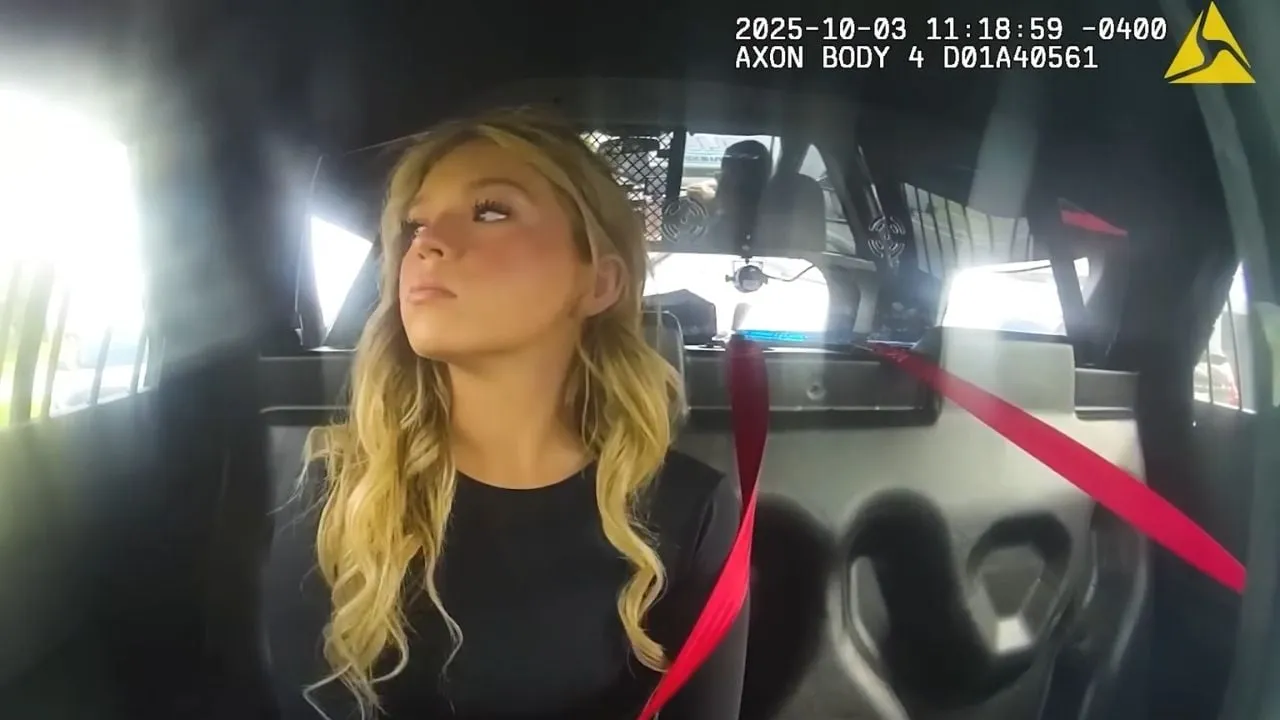
The encounter took place in New Smyrna Beach on Oct. 3, 2025. Much of the attention centers on the same sequence: the driver is arrested, disputes whether she understood an officer was ordering her to stop, then calls her father and gets chewed out in front of police. The video leaves the story in one place. The court case ended somewhere else.
New Smyrna Beach Police Officer Scott Riera was investigating an unrelated hit-and-run crash on Pioneer Trail when, according to his arrest affidavit, he heard a 2024 Ford Mustang GT approaching and saw it cross the double yellow line to pass another vehicle. He wrote that the Mustang “appeared to be traveling well over the speed limit.”
She Kept Going
Embedded media follows; please allow a moment for it to load.
Riera wrote that he stepped onto the asphalt shoulder and raised his hand toward the approaching Mustang in an effort to get the driver to stop. He said he stayed out of the travel lane because he was concerned about being struck.
The Mustang continued past him.
Riera ran back to his patrol vehicle and issued a BOLO but was unable to locate the car on Pioneer Trail. A short time later, while driving through the Coastal Woods subdivision, he spotted it parked near a residence.
The driver, Tara Ashley Palmieri, later walked into the garage, where Riera approached her.
“Put your hands behind your back; you’re under arrest for fleeing and eluding law enforcement,” he told her.
She argued that she did not have to stop because Riera had been standing on foot rather than attempting a traffic stop from a patrol vehicle with emergency lights activated.
“I absolutely don’t need to have, like, sirens activated,” he told her. “I’m a fully uniformed law enforcement officer telling you to stop.”
As police prepared to tow the Mustang, she called her father and tried to explain what had happened. Riera eventually joined the conversation.
“Quiet, quiet! Quiet up, or you’ll stay in that place for a week,” her father told her. “You’re being cocky; you’re not even being polite; you’re not even using manners.”
He also warned that the arrest could jeopardize the nursing career she was working toward. The exchange became a large part of the clip people kept sharing: a young driver in handcuffs, her Mustang about to be towed and her father dressing her down in front of police.
Black and White
Palmieri said she saw “a guy in black and white” at the roadside and did not understand him to be a police officer ordering her to stop. Viewers picked up on the same issue. Some compared Riera’s white shirt, dark pants, and boots to private security or a gate guard, while others argued that a uniformed officer raising his hand should have been enough.
Carscoops highlighted the dispute in December 2025, including Palmieri’s description and Bryan’s argument that Riera could have looked more like private security than an obvious police presence.
Florida law does not require a marked patrol car, flashing lights, or a siren for the basic fleeing charge she faced. Under Florida Statute 316.1935(1), prosecutors still had to prove that she knew a duly authorized law enforcement officer had ordered her to stop and then willfully refused or failed to do so.
Florida courts have wrestled with what someone understood from a police signal. In Goodman v. State, a bicyclist looked back at a patrol vehicle after the officer activated his lights, kept riding, then got off his bicycle after the officer gave the siren a short yelp. When the officer later shouted for him to stop, he immediately complied.
The Second District Court of Appeal said a stop order can be communicated without words, but there still had to be evidence that the person perceived the signal and understood it was directed at him. The court found the earlier lights and siren ambiguous enough that they did not establish he knowingly refused an order to stop.
Another Florida case involved plainclothes officers approaching a truck in an unmarked vehicle. In Houston v. State, the officers did not initially use emergency lights or sirens, display weapons, or give commands. Their approach was so unobtrusive that one of the people at the scene did not realize the men were law enforcement officers even after noticing them.
Courts outside Florida have confronted the other side of the problem. In a Wisconsin case, a driver argued that he did not know the man confronting him was an officer because the officer wore plain clothes, did not announce himself, and did not display a badge. Other details cut against him: the vehicle had red-and-blue lights and a siren, the officer followed him, blocked the road, drew a gun and gave commands, and four bystanders understood that he was law enforcement.
The Case Had a Different Ending
Bryan raised his own concerns while Palmieri’s felony case was still pending. In his December 2025 analysis, he questioned whether prosecutors could prove she knew Riera was ordering her to stop. He also argued that her later warrantless arrest raised Fourth Amendment problems and disputed whether Riera’s search for the Mustang amounted to the immediate and continuous pursuit needed for a hot-pursuit exception.
Bryan predicted that the felony charge should be dismissed.
Public Volusia County court records show prosecutors filed a nolle prosequi on June 18, 2026, ending the felony case. The docket does not say why, so it does not reveal whether prosecutors shared any of Bryan’s reasoning.
A separate citation for passing in a no-passing zone was dismissed on March 18, 2026.
The arrest footage leaves her in handcuffs on a felony charge, with her father warning that the case could affect her future. The court record gives the circulating video a different ending.