A Backyard Visitor Turned Out to Be a ‘Ghost Squirrel’ and Here’s Why It’s So Rare
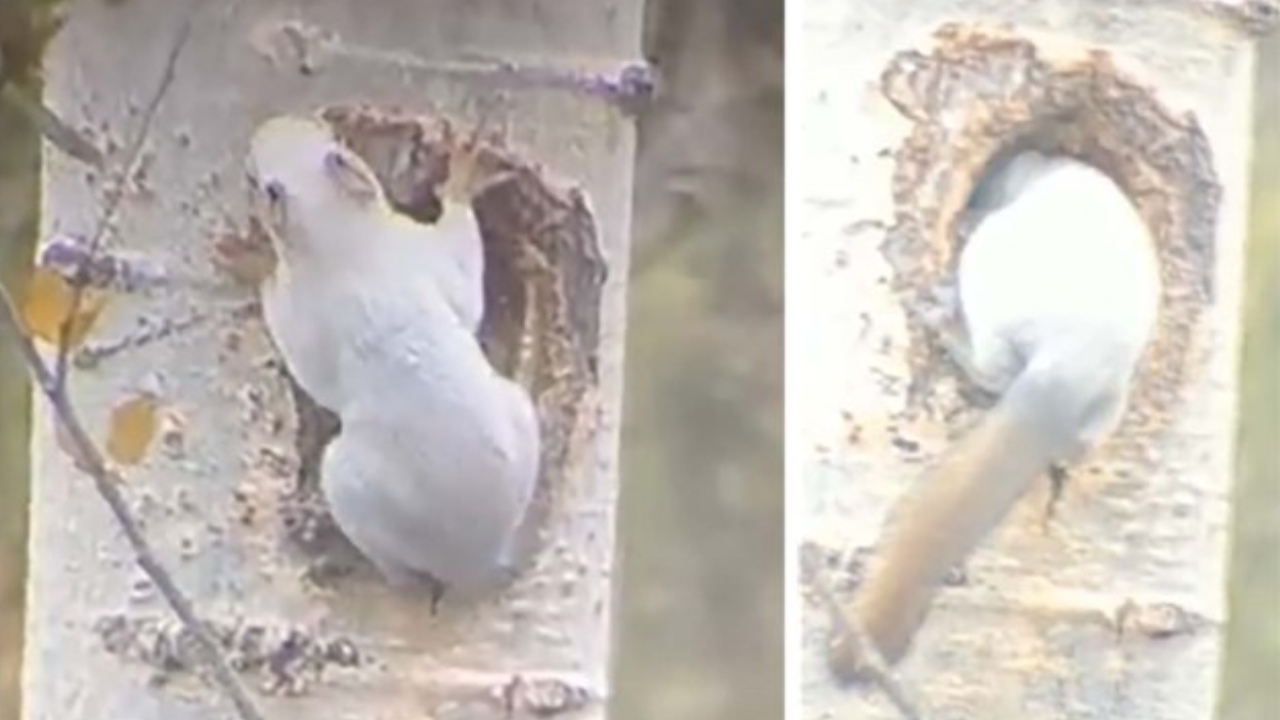
A rare white red squirrel spent about a week in a St. Albert, Alberta, backyard this spring, drawing the attention of the resident who was watching it. Wendy Vanderwel, who lives in the city’s Gardens neighborhood, told the St. Albert Gazette she observed the animal in a backyard tree from May 8 to May 15. Red squirrels normally have red backs, faces, and tails with white undersides, but this one was white nearly everywhere except its tail and the backs of its paws.
The squirrel had been living in a tree cavity that a yellow-bellied sapsucker excavated in Vanderwel’s backyard about two years ago. She first thought the animal might be a flying squirrel, then watched a normally colored red squirrel use the same hole. The color in its eyes and tail told her it was not an albino, which would show no pigment at all.
What she saw instead was a leucistic squirrel, sometimes called a “ghost” squirrel, an animal with a genetic mutation that blocks normal coloring. Local readers may recognize the term from the “ghost” magpie, which turns up gray and white where it should be blue and black. Vanderwel said it was the first such squirrel she had ever seen, and she was delighted by it, adding that she felt “kind of honored it chose our backyard to hang out in.”
White squirrels are an uncommon sight anywhere, and a white red squirrel is rarer still. To gauge how unusual the sighting was, the Gazette turned to Stan Boutin, a retired University of Alberta biologist who spent more than 35 years studying red squirrels. He said he has never seen a leucistic red squirrel in person and has received only about two reports of one.
What a Red Squirrel Expert Made of the Sighting
👀🐿️ Have you ever seen a ghost squirrel? 🤯
A rare white squirrel has been spotted in a St. Albert backyard, and the photos are incredible! 🤍🌳
Some are calling it a “ghost squirrel” because of its striking white coat.
Sightings like this don’t happen every day! 👻🐿️
📖…
— Willy Skinner (@WillyGSkinner) July 9, 2026
Boutin said leucistic red squirrels are extremely rare. One of the two reports he had received was of a white-tailed red squirrel spotted in St. Albert’s Forest Lawn area in 2016, where a red squirrel with white paws also turned up around the same time, according to the Gazette. Looking at a video Vanderwel recorded of the squirrel and its hole-mate, Boutin judged that both animals were juveniles.
Adult red squirrels are usually solitary and fiercely territorial, though juveniles will sometimes linger near their birth nest before moving on to claim their own turf. Boutin said the rarity of white red squirrels points to leucism being an evolutionary disadvantage, since the pale coat likely makes the animals easier for predators to spot and less likely to survive and pass on the trait. He encouraged anyone lucky enough to see one to simply enjoy it, calling it “just a beautiful-looking animal.”
What Is a Leucistic ‘Ghost’ Squirrel?
A leucistic animal has a genetic mutation that strips away much of its normal color while leaving the eyes their usual dark shade. That eye color is the quickest way to separate a leucistic squirrel from a true albino, which produces no pigment at all and has pink or reddish eyes. Vanderwel used exactly that test, noting the color in the squirrel’s eyes and tail before ruling out albinism.
Most white squirrels in North America are leucistic or albino gray squirrels, according to the White Squirrel Institute, and towns like Brevard, North Carolina, are known for populations of them. A white coat is generally a liability in the wild, since it makes an animal easier for predators to see, which is part of why the trait stays scarce. Vanderwel last saw her white visitor on May 15 and hoped it would show up again.