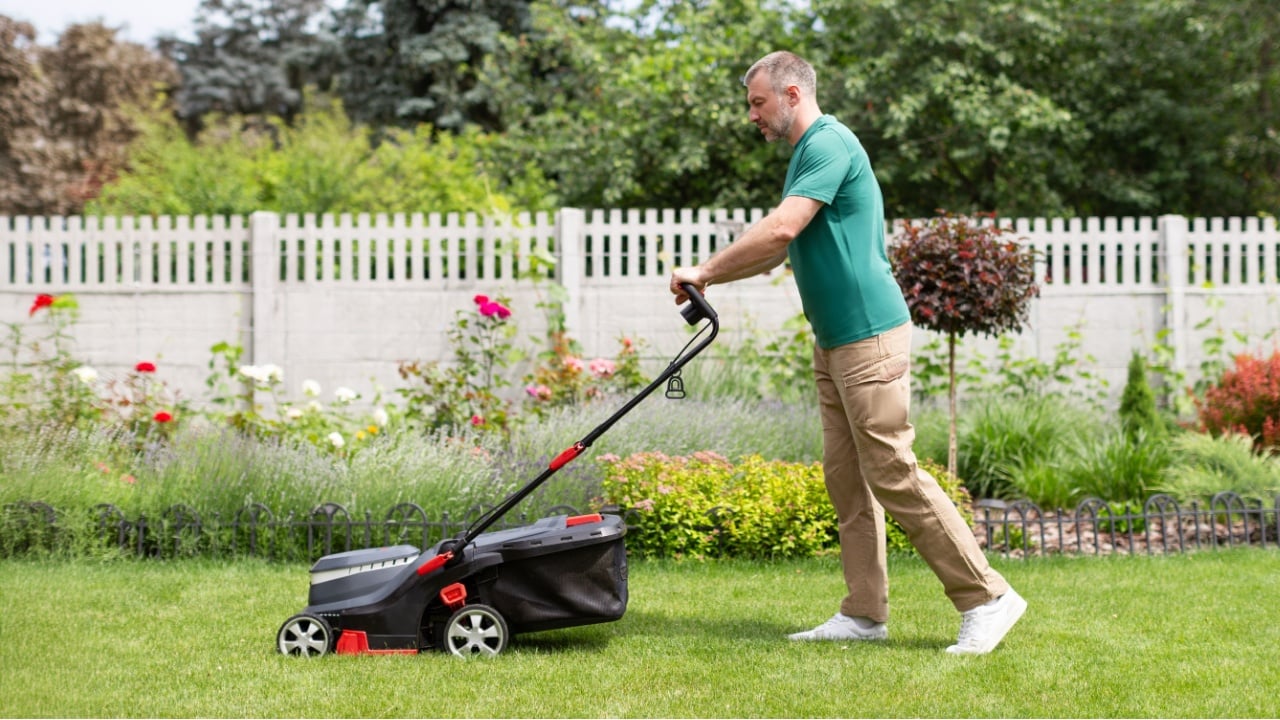
Gardening Influencer Hilariously Explains All the Drawbacks of Grass
The perfectly manicured lawn is one of the most unquestioned habits in modern homeownership. Most people maintain one without ever stopping to ask why. Chef and urban farmer Jason Michel Thomas, who posts to Facebook, has a clear answer: there is no good reason.
Thomas posted a reel that laid out the case against conventional lawns quickly and directly. His caption opened with a simple line: “Your lawn doesn’t need to be a golf course.” The reel and caption explain where the obsession with perfect grass came from and what a better alternative looks like.
The problem, as Thomas explains, runs deeper than aesthetics. Most lawn grass is a non-native monoculture that crowds out plants that local wildlife actually depends on. Meanwhile, the so-called weeds being pulled and sprayed are, in many cases, far more useful.
This article follows the thread of Thomas’s reel, covering the real cost of conventional grass, the history behind it, and the plants that do more for a yard than grass ever has.
Grass is Thirstier and More High Maintenance Than It’s Worth
Thomas opens his reel with a direct comparison, describing grass as “thirstier and more high-maintenance than your ex.” Most homeowners spend considerable time, money, and water on it every season.
As Thomas notes, it amounts to maintaining a monoculture crop that gives nothing back.
The effort might make sense if grass served a purpose, but its primary function is to look neat. It produces no food, supports no pollinators, and carries no medicinal value. The return on investment is remarkably poor.
The Perfect Lawn Was Always a Wealth Signal
Thomas traces the lawn’s origins in his reel, asking viewers if they are a “17th-century noble lord rubbing peasant noses in enormous wealth by not farming the lawn.”
Historically, the perfect green lawn was a status symbol because only the wealthy could afford to grow something that “didn’t do anything except look pretty.”
The trend stuck, Thomas notes, and most people are now spending significant time, money, and water maintaining that inherited habit. It became a neighborhood standard rather than a considered choice. Few people have examined where it actually came from.
Most Lawn Grass Isn’t Even Native
Thomas points out in his caption that most grass species in conventional lawns are not native.
Non-native grass does not serve local wildlife, and it crowds out the plants that do.
The yard looks full but is ecologically empty. The plants being displaced are the ones that actually serve local wildlife.
The Plants Called Weeds Are Actually Useful
Thomas goes through five weeds that are actually quite useful. Every part of the dandelion is useful, and the roots can be roasted for a coffee alternative.
Purple violet is rich in vitamin C. Purple deadnettle has historically been used to alleviate joint pain.
Creeping charlie, also known as ground ivy, was used in beer making before hops became the standard, and it still makes a medicinal tea.
Cleavers can be brewed into a tea and used to reduce swelling. These are plants with real, documented uses growing freely in yards where they are routinely removed.
“Weeds” Are the First Food Pollinators to Get After Winter
These plants (as mentioned above) are among the first food sources for bees after long, hard winters. They bloom early when not much else is available, and that timing makes them vital for supporting pollinator populations.
Pulling or spraying them in early spring removes one of the few food sources bees have at their most vulnerable.
Leaving them alone costs nothing, and Thomas is direct: these plants are vital for supporting pollinators.
Wild is Not Chaotic, It’s Alive
Thomas closes with a call to redefine what a beautiful lawn looks like. The pressure to maintain perfectly green, weed-free grass is a habit rooted in wealth culture, maintained by convention, and supported by very little practical reasoning.
These plants stay low to the ground, which means less mowing and less watering. The yard that results is not a neglected one. It is a functional one that requires far less upkeep than a conventional grass lawn.
It also means more time for anything other than pushing a mower in 90-degree heat. A biodiverse lawn is not just beautiful. It is purposeful. Wild is not chaotic. It is abundant, generous, and alive.
Read More:
How a Dutch Company is Turning Concrete Jungles Into Green Space
How a Company in India is Tackling Plastic Pollution by Feeding the Hungry