Scientists Identify Giant 66-Pound Rodent That Lived 34 Million Years Ago
For something so small these days, rodents can invoke an array of strong emotions: some find them adorable and cuddly; others recoil in fear. Well, imagine coming across a rat weighing 66 pounds. How might that change things?
That is roughly the size scientists believe a newly identified prehistoric rodent may have reached some 34 million years ago, long before the typical teeny rats and mice we know today.
Scientists have named the animal—discovered in what is today southern Thailand—Yakamys sirindhornae. Scientists identified the enormous creature from just two fossilized teeth discovered in a coal mine more than 20 years ago.
One such tooth was so unusually large that the geologist who discovered it initially thought she’d found an entire bone. Thanks to this fossil, an international research team was at last able to identify a previously unknown species that actually dwarfed most of its other rodent contemporaries. Talk about a big difference.
On Nov. 4, the findings were published in the scientific journal Scientific Reports, which features contributions from researchers from Thailand, France, and Canada’s McGill University, and offers new evidence about when giant rodents first appeared.
A Strange Discovery in a Thai Coal Mine
Embedded media follows. Please allow a moment for it to load.
View this post on Instagram
Besides the rodent’s birthday of some 34 million years ago, this story of monumental discovery began in 2004, when researchers were examining fossil deposits at a coal mine in Thailand’s Krabi Province. Among their discoveries were a large molar and an incisor, both preserved in sediment.
Pannipa Tian, a geologist with Thailand’s Department of Mineral Resources, discovered the incisor. Speaking to Agence France-Presse, Tian recalled that its unusual size initially threw her off. She brought it to her supervisor, who recognized it as the tooth of an exceptionally large rodent.
At the time, the team lacked enough information to determine precisely what kind of animal the teeth belonged to. More than two decades later, scientists were able to examine their structure in greater detail and establish that they represented a species that had been previously unknown to science.
Yakamys sirindhornae has a name rife with meaning. The first part combines the Thai word for giant, yak, and the Greek mys, meaning mouse or rat. The second honors Thailand’s Princess Maha Chakri Sirindhorn for her longstanding support of scientific and paleontological research.
Just How Big Was This Prehistoric Rodent?
To estimate the animal’s weight, researchers utilized seven separate, established mathematical methods that use the dimensions of a creature’s teeth to predict body size. Their calculations varied considerably, and ultimately the team settled on around 66 pounds as a reasonable estimate.
That would have made Yakamys roughly twice as heavy as some other rodents known from the same geological era. However, it is important to remember that study co-author Virginie Millien, a biology professor at McGill University, emphasized that the figure remains a rough estimate because scientists have so little fossil material to work from.
Scientists already knew that prehistoric rodents in South America did, indeed, grow to awe-inspiring sizes; the discovery of Yakamys suggests that giant rodents were also roaming Southeast Asia over 30 million years ago—much earlier than researchers had previously established for that region.
In fact, this discovery is particularly exciting because it provides rare, early evidence of something scientists call rodent gigantism, the evolution of unusually large bodies in certain rodent lineages. The fossilized teeth suggest that this evolutionary phenomenon was taking place much earlier. As the researchers explain in their study published in Scientific Reports, unusually large rodents had already evolved in Southeast Asia during the Eocene, a period when most known members of the group were considerably smaller. Yakamys sirindhornae adds a surprising early chapter to the history of rodent gigantism.
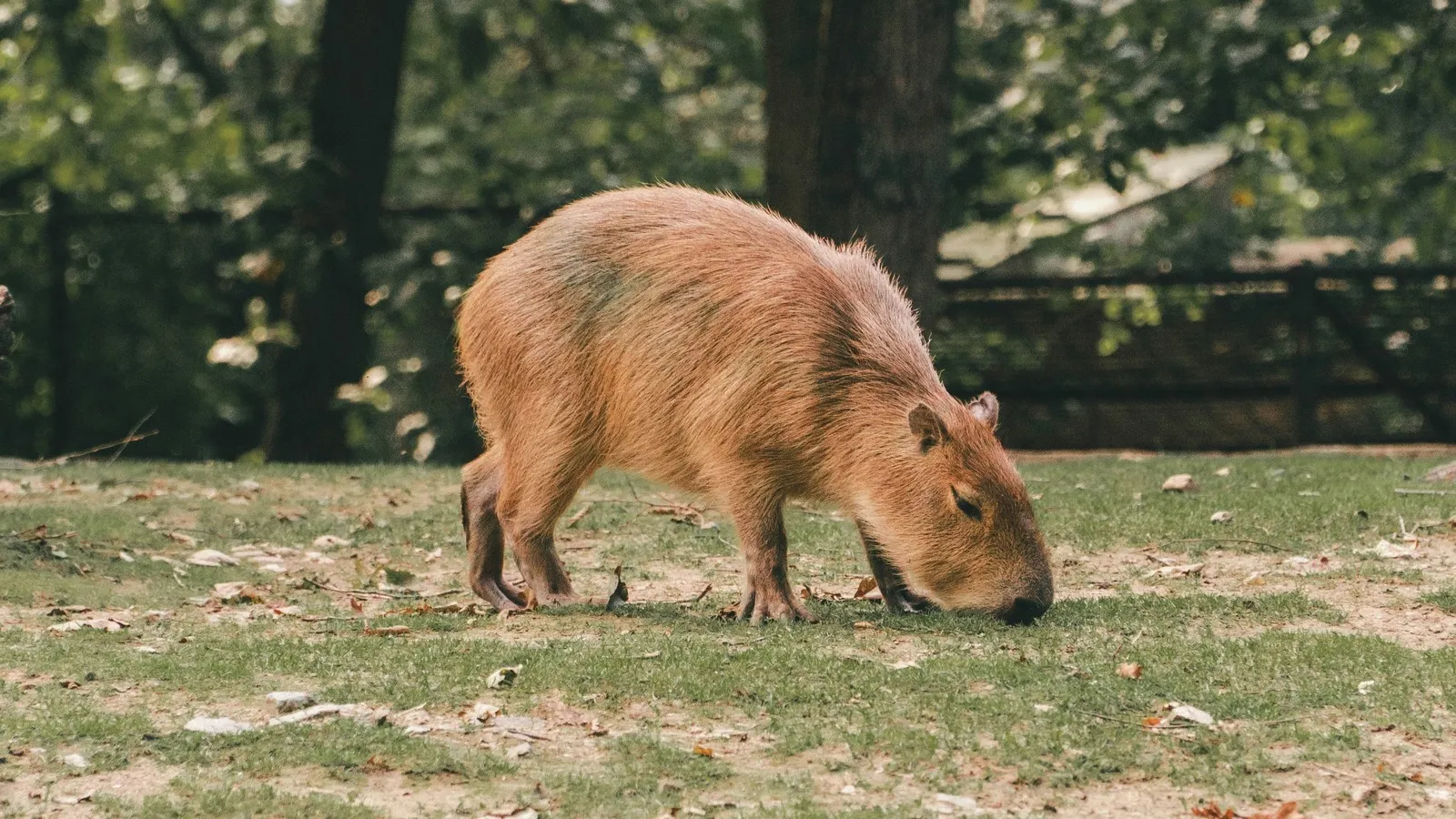
Today, the title of world’s largest living rodent belongs to the capybara, a highly beloved South American animal that might be understandably mistaken for an oversized guinea pig. According to the San Diego Zoo, these gentle-looking giants can grow more than four feet long and weigh up to 174 pounds. For context, some modern capybaras can outweigh the newly discovered prehistoric rodent by more than 100 pounds!
Who knows what else nature has in store for these and other rodents?