Cause of Death Revealed For Jackie, Beloved Bald Eagle of Big Bear Lake
Two months after Jackie, the beloved bald eagle whose nest captivated millions of viewers, died at age 14, wildlife officials have revealed what caused her death.
The California Department of Fish and Wildlife announced Oct. 14 that highly pathogenic avian influenza, commonly known as bird flu, was the primary underlying cause of Jackie’s decline.
The infection caused an unusually severe stomach ulcer, leading to persistent internal bleeding, anemia, and a dangerous bacterial infection. Extensive testing helped explain the mysterious medical complications that had troubled veterinarians during her final weeks.
Jackie died Aug. 10 after more than three weeks of intensive treatment at the Ojai Raptor Center in California. Her loss was felt far beyond Big Bear Valley, where viewers had spent years watching her raise eaglets alongside her longtime mate, Shadow.
Jackie Became An Internet Sensation Alongside Shadow
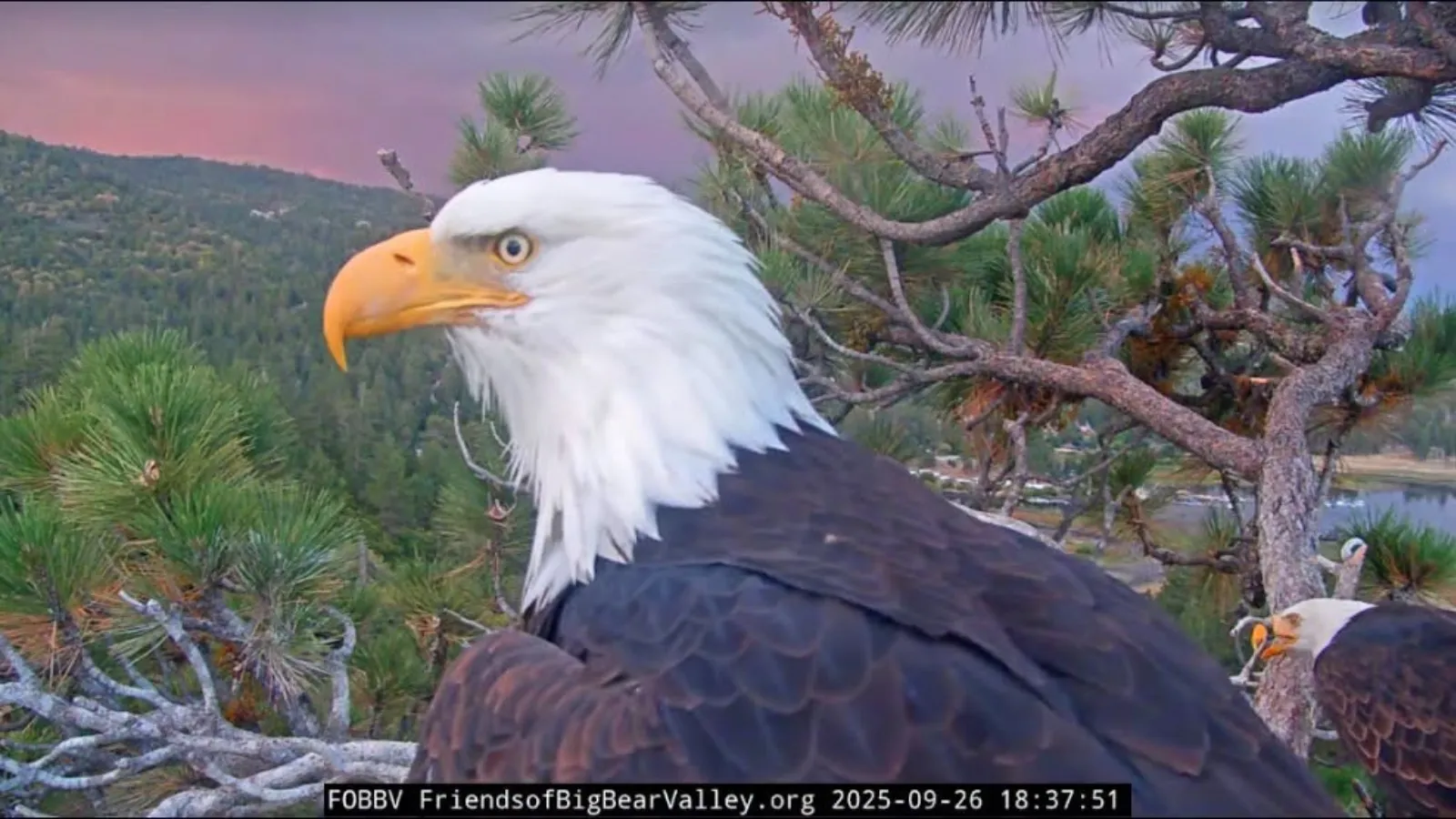
Born in 2012, Jackie was the first bald eagle known to have hatched in Southern California’s Big Bear Valley. Her life eventually became the subject of a 24-hour nest camera operated by the nonprofit Friends of Big Bear Valley.
Jackie took over the camera-monitored nest during the 2016–2017 nesting season. Shadow arrived in 2018, eventually becoming her longtime partner, and their adventures attracted a devoted audience.
The feathery soulmates experienced triumph and heartbreak whilst raising their young. Their 2025 nesting season produced two surviving eaglets, Sunny and Gizmo, following a powerful snowstorm. In April 2026, they welcomed two more, Luna and Sandy.
Their popularity also helped draw attention to conservation efforts around Big Bear Lake, including a successful campaign to protect nearby eagle habitat from development.
What the Final Examination Revealed About Jackie’s Death
Jackie’s final ordeal began July 17, when she was found injured after an encounter with two younger eagles. She was taken to the Ojai Raptor Center, where veterinarians discovered severe anemia and struggled to determine why her blood levels continued declining.
Her condition worsened despite intensive care, and she died Aug. 10.
The final examination, performed by veterinary pathologists with the San Diego Zoo Wildlife Alliance, found that bird flu had caused extensive damage to her digestive system. The resulting blood loss and secondary bacterial infection contributed to her death.
According to the California Department of Fish and Wildlife, testing also detected brodifacoum, a chemical used in some rodent poisons, in Jackie’s liver. However, investigators did not find the uncontrolled bleeding typically associated with that poison and did not identify it as the primary cause of her illness or death.
“Jackie’s necropsy confirmed Highly Pathogenic Avian Influenza (HPAI) as the primary underlying cause of her decline,” said Steve Kubiski, the alliance’s director of disease investigations, in the state’s announcement.
Her remains were cremated under procedures intended to prevent the spread of bird flu.
Shadow remains in Big Bear Valley. According to the California Department of Fish and Wildlife, nest camera footage has shown no signs of illness in Shadow or Jackie’s eaglets, offering some bittersweet reassurance to the community that followed the eagle family for years.