California’s $114 Million Freeway Crossing Has Its First Four-Legged Visitors
California spent $114 million building a bridge over one of its busiest freeways, and drivers aren’t allowed anywhere near the top. Instead, the new crossing is meant for mountain lions, deer, coyotes, and other wildlife that have spent decades trapped on opposite sides of the road.
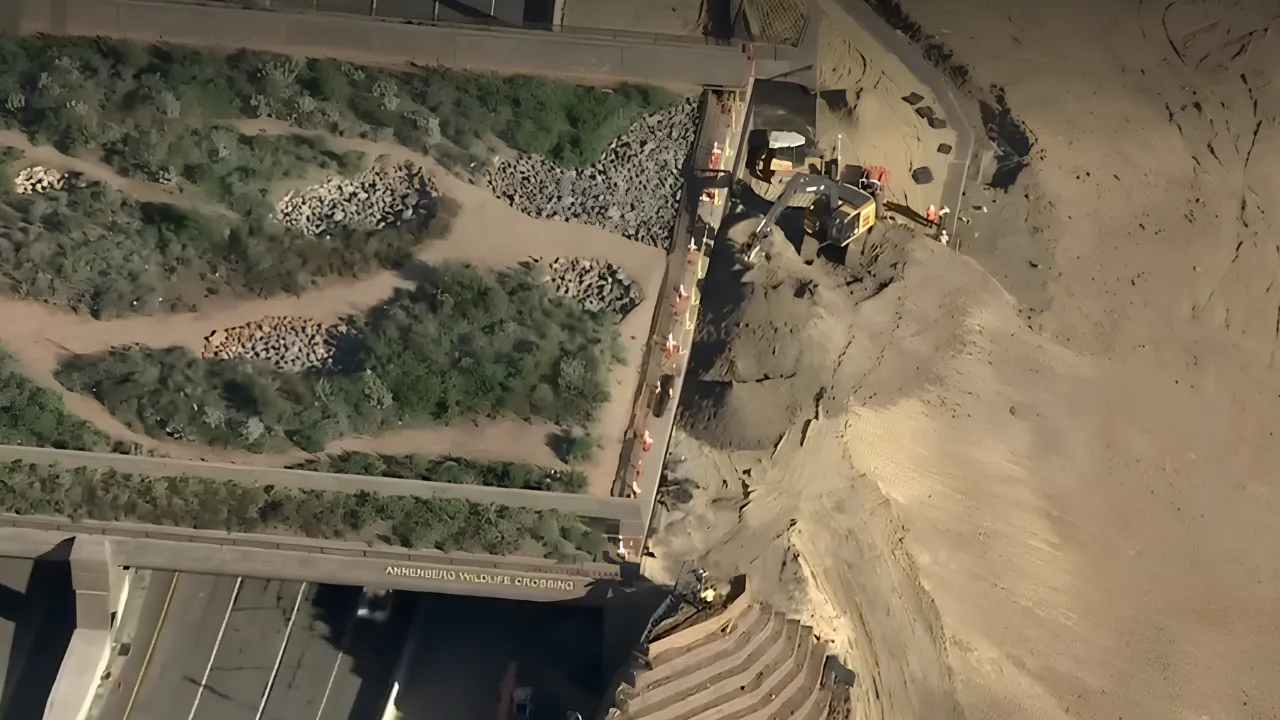
The Wallis Annenberg Wildlife Crossing in Agoura Hills is set to open December 2, following four years of construction. Stretching across 10 lanes of the 101 Freeway, the 210-foot structure will link the Santa Monica Mountains with open land to the north. Another bridge carries animals over nearby Agoura Road.
Some wildlife apparently couldn’t wait for the grand opening. Cameras have already caught coyotes exploring the unfinished structure, giving researchers their first look at how animals might respond to a bridge built just for them.
For the people behind the project, those early visitors are encouraging. Still, the crossing has a much bigger job ahead. Beyond keeping animals out of traffic, it could help save a mountain lion population that has struggled with years of isolation and inbreeding.
First Across The Bridge
Embedded media follows; please allow a moment to load.
On October 28, a National Park Service camera photographed a coyote climbing the southern slope of the crossing. Days later, another camera caught a coyote walking along the planted bridge above the freeway.
At the time of the first sighting, construction had not yet joined every section of the route. The photographs therefore show animals exploring the project, rather than proof of a complete trip between the mountains.
Even so, scientists have good reason to watch closely. More than 300,000 vehicles travel through this stretch of freeway each day, making it a dangerous barrier for animals trying to reach new territory.
The National Park Service is installing cameras to record which species use the crossing and how often they visit. Nearby trails already attract bobcats, gray foxes, mule deer, coyotes, and mountain lions.
Trapped By Traffic
The bridge may look like an expensive way to keep animals off the road, but its most important purpose is harder to see.
Mountain lions need large areas to hunt, find mates, and raise their young. In Southern California, freeways and development have broken those habitats into smaller pieces.
Researchers have found serious signs of inbreeding among mountain lions in the Santa Monica Mountains. Some have even documented fathers mating with their offspring because the animals have so few chances to find unrelated partners.
A National Park Service study warned that the population could face extinction without better access to other mountain lions. Its models also found that even a small number of new arrivals could greatly improve the animals’ chances.
The problem has already claimed lives. Park researchers have documented at least 32 mountain lions killed by vehicles in their study area since 2002.
A Costly Connection
Building the crossing was anything but simple. Work began in April 2022 with an estimated budget of $92.6 million, but the price eventually climbed to about $114 million.
Heavy rain slowed construction, while utility work and rising costs added to the bill. Crews also had to build a second bridge over Agoura Road and move huge amounts of soil to create a natural path between the structures.
According to Caltrans, the project will restore a connection the freeway cut through decades ago.
Rather than leave animals walking across bare concrete, workers covered the main bridge with soil and thousands of native plants. The goal is to make the route feel like another piece of the surrounding hills.
Still Under Construction
Opening day won’t mean the work is finished. In an interview with KTLA, Beth Pratt, president of the Wildlife Crossing Fund, explained that protective fencing is still going up along the freeway.
Those barriers are essential. Without them, animals could simply enter traffic a short distance from the bridge instead of taking the safer route overhead.
Sound barriers will help shield wildlife from freeway noise, while another 13 acres of habitat need restoration. Crews also have about 50,000 native plants waiting to go into the surrounding landscape.
Pratt is already looking toward similar projects in California and other states, hoping the crossing will encourage more roads to be built with wildlife in mind.
“The ribbon cutting is not an endpoint; it’s a beginning,” she told KTLA.
The December 2 ceremony will mark the crossing’s official opening to wildlife, but researchers will need years to determine whether it successfully reconnects the region’s isolated animal populations. National Park Service scientists plan to track which species use the bridge while studying changes in genetic diversity, vegetation, and other ecological conditions.
For the mountain lions of the Santa Monica Mountains, the real test will be whether the new route eventually brings more unrelated animals into their shrinking population.