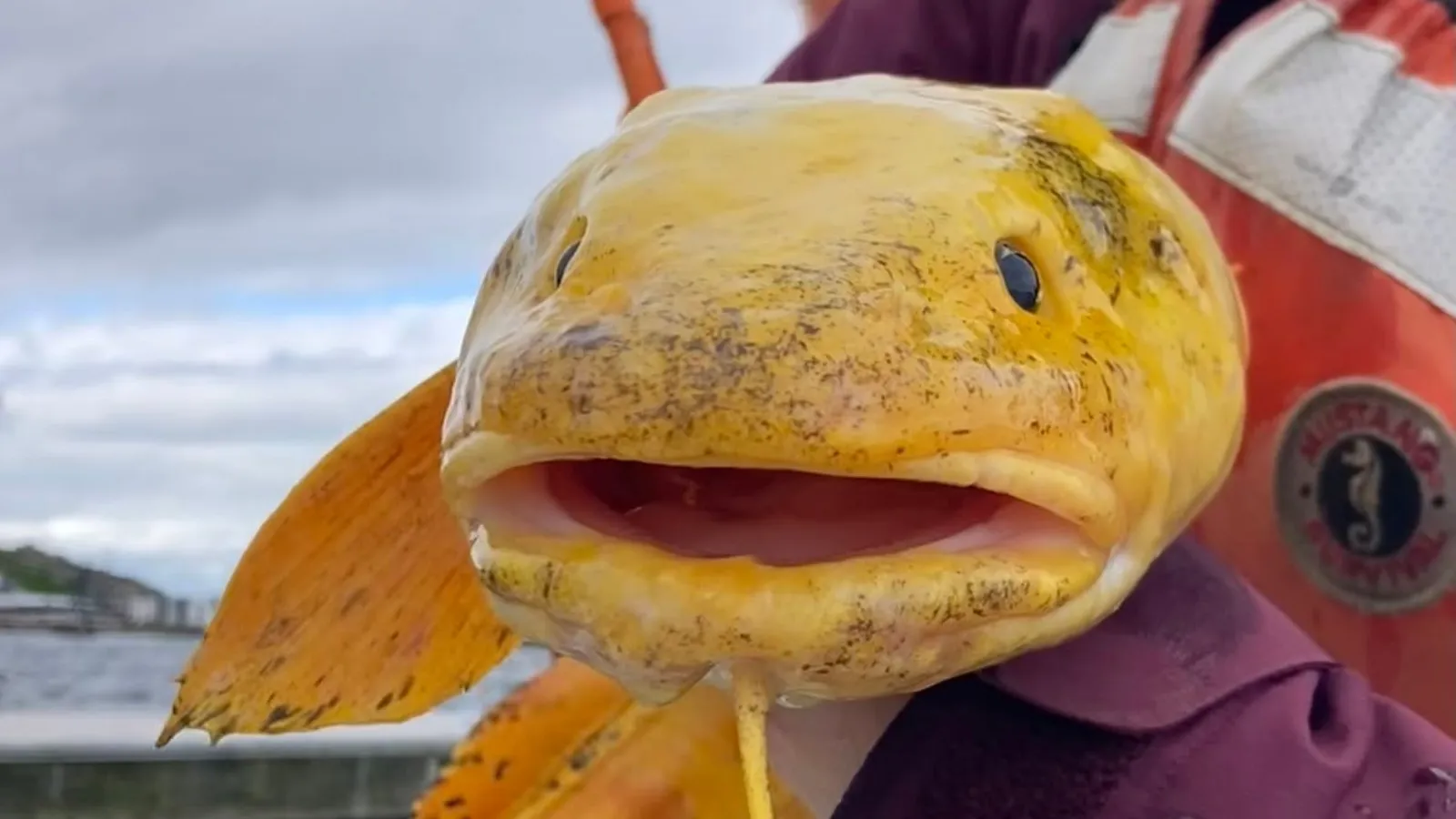
Biologists Searching for Invasive Species Find a Unique And Worrying Yellow Fish
A team of biologists searching for invasive species in New York’s Lake Ontario made a colorful discovery in October when they pulled a vibrant yellow-orange fish from the water. That sunny catch alone was enough to dazzle; however, a closer examination uncovered something far more concerning.
The fish was identified as a burbot. A burbot is a freshwater species native to the Great Lakes that generally favors colder, deeper waters over warm, shallow spaces.
And its population in Lake Ontario has dwindled to exceptionally low numbers.
The odds of encountering a burbot in Oswego Harbor were already negligible. For one to appear in such brilliant colors was extraordinary, though it comes with implications that are raising concerns for the species’ future.
The U.S. Fish and Wildlife Service announced the find on Nov. 10, revealing that the fish had been sent to Cornell University for further examination. Just what was so alarming about this fish, and what does it mean for the species going forward?
An Extraordinary Catch With an Unusual Condition
Embedded media follows. Please allow a moment for it to load.
The fish’s golden appearance comes from xanthochromism. This rare genetic condition affects normal pigmentation—in other words, how a creature can safely exist in its native habitat. Burbots ordinarily have muted brown or olive coloring that helps them blend into their underwater surroundings. This fish was impossible to mistake for a normal burbot—and equally impossible to miss, whether the observer is a human or a predator.
The agency called the discovery a “one-in-a-million” catch, and rightly so; xanthochromism is even less common among wild fish than albinism, according to the Fish and Wildlife Service.
The location presented a whole other surprise of its own. Every now and then, anglers will occasionally report catching burbot around Oswego Harbor; this one was the first time scientists had officially documented one during a fisheries survey there.
At first, there was excitement. Soon, that dissolved in the wake of some somber data. Biologists from the U.S. Geological Survey noted that the fish was severely underweight and appeared to be in poor health outright. They arranged for it to undergo further examination at Cornell University’s College of Veterinary Medicine, where experts could investigate what might be wrong.
A Rare Discovery Could Help Scientists Protect Other Fish
The team responsible for the discovery works with the Fish and Wildlife Service’s Aquatic Invasive Species Early Detection and Monitoring Program. Its mission is to identify potentially harmful newcomers before they become widespread in Great Lakes waterways.
To accomplish that, scientists rely on several detection techniques. Some involve collecting fish directly with specialized nets, while others analyze traces of DNA left behind in the water. The approach is designed to locate species that may be present in very small numbers.
Catching such an unusual native fish was an unexpected result. It also demonstrated that the survey could uncover species that are already difficult to find, a capability that could prove valuable when searching for invasive fish before their populations expand.
The yellow burbot may offer another benefit. Scientists hope its veterinary examination will provide clues about the poor health of individual burbot and exactly which factors are limiting their numbers in Lake Ontario.
What is the most unusual catch you have reeled in or seen someone else reel in?