North Carolina Beach Homes Are Collapsing, and Taxpayers Are Helping Clean Up the Mess
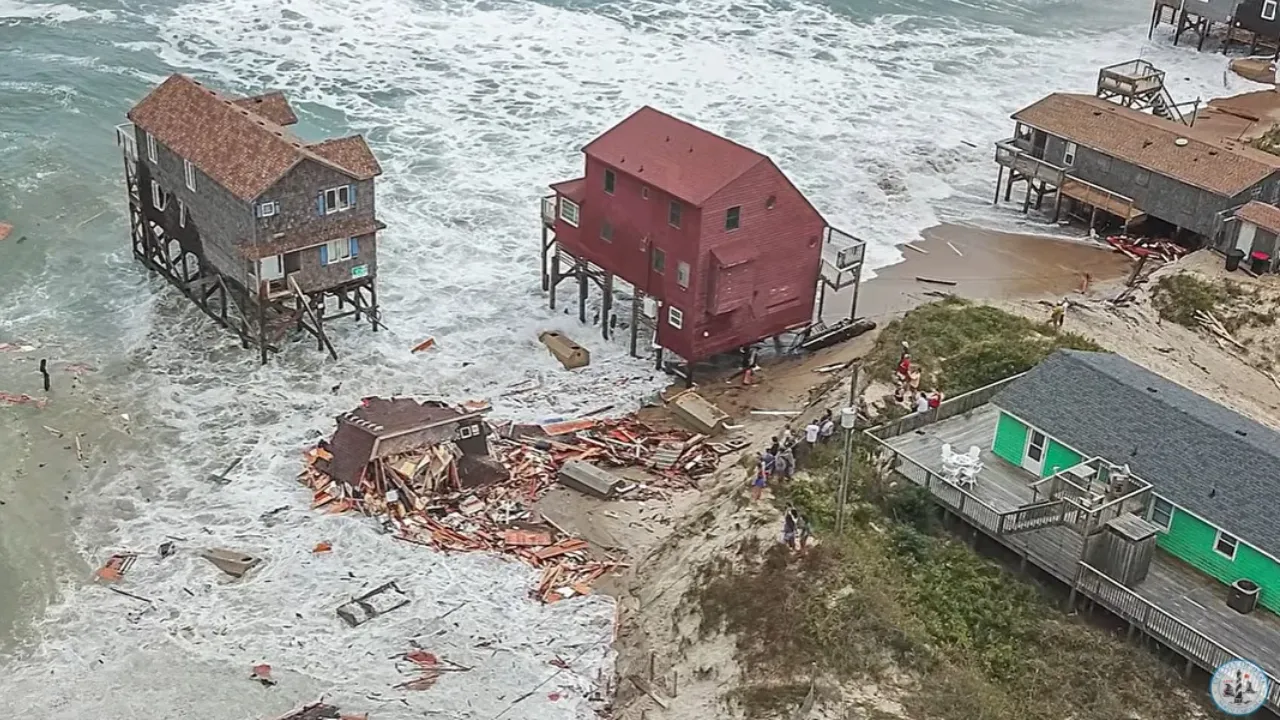
North Carolina beach houses are falling into the Atlantic Ocean, leaving piles of broken wood, nails, and personal belongings scattered along the coast. But some owners have a financial reason to wait for their homes to collapse instead of tearing them down.
In Dare County, North Carolina, 32 privately owned houses fell along Cape Hatteras National Seashore between May 2020 and June 2026. Most were in the villages of Rodanthe and Buxton, where waves have steadily eaten away at the shoreline.
Many of these houses were not built at the water’s edge. Decades ago, they stood several rows back from the beach. Now, the ocean has reached their foundations, leaving some buildings standing in the surf.
An NPR investigation found that federal flood insurance rules can make it difficult for owners to remove these houses before they fall. The problem has sparked frustration among residents and viewers, who question why so much debris is being left for others to clean up.
A Costly Waiting Game
Embedded media follows; please allow a moment to load.
The problem comes down to how flood insurance works. Under the National Flood Insurance Program, homeowners may qualify for up to $250,000 in building coverage and another $100,000 for belongings.
However, Dare County explains that the program does not cover the cost of moving a threatened house to another lot. Owners generally cannot collect a payout simply because their home is in danger from gradual erosion.
Moving a house means finding another property and paying for the move. Demolition also comes with a large bill. For owners who cannot afford either option, waiting for a covered loss may be their only practical choice.
In an official county video, Dare County Manager Bobby Outten described how a homeowner might receive $250,000 after a collapse, spend $30,000 to $50,000 cleaning up debris, and still have money left.
Actual payments depend on the policy and whether the damage qualifies for coverage. Still, the example shows why removing a house early can leave owners in a difficult financial position.
Once Far From Water
The idea that these homes were built directly in the ocean has drawn criticism online. But county records tell a different story.
Most were constructed during the 1970s, 1980s, and 1990s, when the beach was much wider. Some stood four or five rows behind the oceanfront.
In Dare County’s video, “The Fight to Protect the Outer Banks,” local officials explain that erosion has accelerated in recent years. Some stretches of shoreline have been retreating by more than 10 feet annually.
With each passing year, the sand beneath the homes disappears. Pilings become exposed, stairs are washed away, and sections of the buildings can break apart.
According to the National Park Service, 20 homes collapsed in Buxton between September 2025 and June 2026 alone.
The Mess Left Behind
When a house finally falls, the damage can spread far beyond its former property line.
Waves carry insulation, furniture, shattered glass, and wood filled with nails along public beaches. The debris can threaten wildlife, force beach closures, and create hazards for visitors.
Property owners are responsible for cleanup costs. Yet the National Park Service reports that owners’ efforts have not always been enough, forcing park staff and contractors to step in.
That problem has fueled criticism on NPR’s Facebook post.
“Once the house collapses, the owner should be responsible for any debris left on the beach,” commenter Penny Clark wrote.
Another commenter, Katie Johnson, pointed to the changing coastline: “Don’t build on barrier islands because they move.”
Dare County’s historical records show why the issue is more complicated. Many homeowners bought or built properties that were far from the surf at the time, only to watch the shoreline move closer.
Paying to Stop It
Officials have explored ways to prevent more collapses. One option is beach nourishment, which adds sand to replace what the ocean has washed away.
For Rodanthe, that work was estimated to cost roughly $40 million. Dare County sought federal funding but was not awarded the grant, and maintaining the added sand would require further spending.
Another approach is buying threatened houses and removing them before they collapse.
In 2023, the National Park Service purchased two properties in Rodanthe and demolished the houses. The sites were restored to open beach.
A newer project received $1.05 million in federal and state funding in October 2026 to acquire and demolish three more threatened houses, including one known as the Black Pearl. The purchases remain voluntary and have not yet been completed.
According to Island Free Press, FEMA is providing $793,000, while North Carolina is contributing another $258,000.
If the owners accept the offers and the purchases go through, the houses will be removed and the land preserved as open space, with residential rebuilding prohibited.