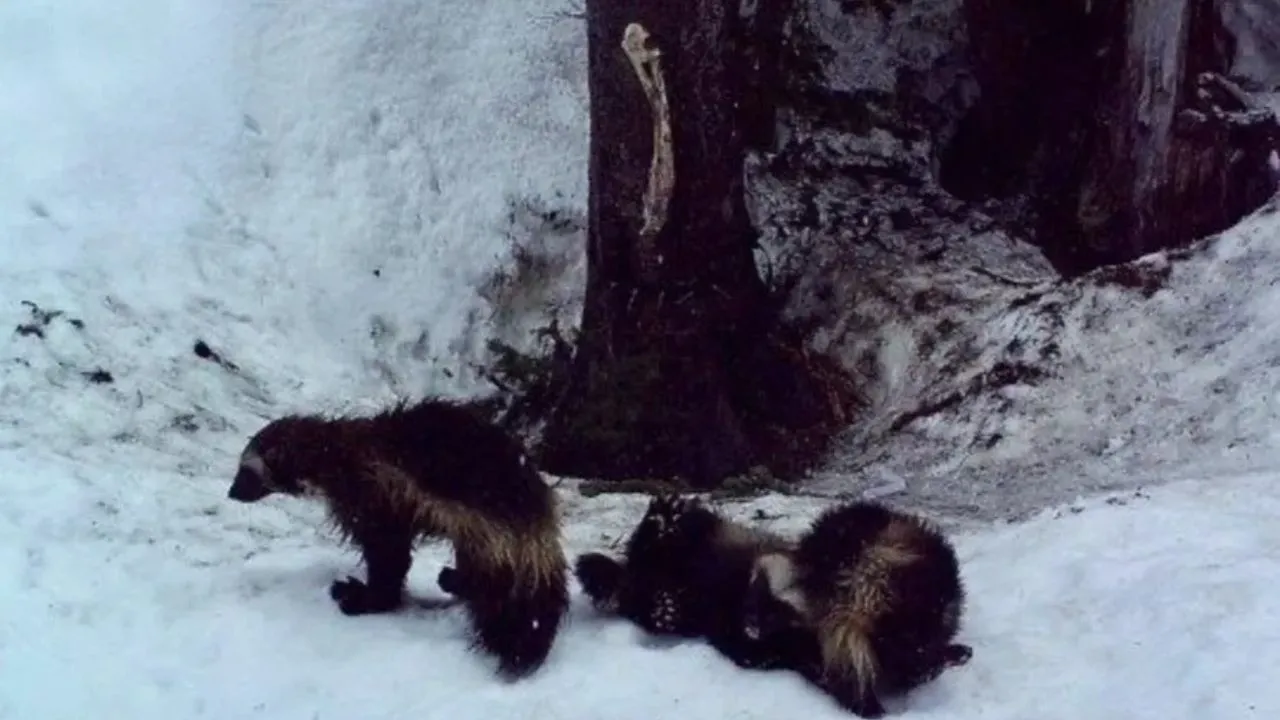
Rare Wolverine Mom Raises 5 Litters in Washington Park Where Breeding Hadn’t Been Seen in 100 Years
A rare wolverine mother at Washington’s Mount Rainier National Park has raised five litters of babies, giving scientists a remarkable look at a species that once disappeared from the region. Her growing family has become one of the park’s most important wildlife discoveries in more than a century.
The story began in 2020, when hidden cameras captured a female wolverine with two young kits. Researchers named her Joni and soon learned that she was doing something no wolverine had been confirmed doing inside the park for over 100 years: raising a family.
What happened next was even more surprising. Joni continued having babies, including a set of triplets, while cameras revealed that her mate and older offspring sometimes spent time together. The footage challenged the belief that wolverines live almost entirely alone.
But the family’s success has come during a troubling period for wildlife in the Cascade Mountains. Warmer winters are reducing the deep snow that wolverines need to shelter their babies and store food, leaving scientists concerned about what future generations could face.
A Century in Waiting
The National Park Service announced the discovery of Joni’s first two kits on August 20, 2020. It marked the first confirmed breeding female with offspring inside Mount Rainier National Park in more than a century.
Wolverines once lived throughout Washington’s Cascade Range. By the 1920s, however, they were believed to have disappeared from the southern mountains after years of trapping, shooting, and poisoning.
Their return began slowly as animals moved south from Canada and spread into parts of Washington where they had once lived. Scientists spent more than two decades searching the Cascades for signs that the population was recovering.
In 2018, researchers led by Dr. Jocelyn Akins of the Cascades Carnivore Project began placing wildlife cameras around Mount Rainier. The cameras were designed to photograph the light-colored markings on each animal’s chest, which are different enough to help identify individual wolverines.
The team also collected hair samples for DNA testing. Those samples helped confirm where the animals came from and whether they belonged to the recovering population in Washington.
Joni was first detected inside the park in late 2019. When researchers later confirmed her first litter, the discovery showed that wolverines were doing more than simply passing through.
“It’s really, really exciting,” said Chip Jenkins, the park’s superintendent at the time.
The Family Grows
A year after the first discovery, researchers returned to a remote part of the park where they believed Joni had made her den. Photographs and videos collected in June 2021 revealed another two kits.
The National Park Service confirmed the second litter that August, marking another important step in the species’ return.
By March 2026, the Cascades Carnivore Project had an even bigger story to tell.
According to a research update, Joni raised four litters in consecutive years, including three kits in 2023. She did not reproduce in 2024 but returned with another kit in 2025, bringing her documented total to five litters.
The cameras also captured behavior that scientists had not expected to see so often.
In 2023, Joni brought her triplets, then about four or five months old, to a monitoring station. Her mate, Van, appeared with them as the family moved through the area.
Male wolverines were once thought to leave females after mating, with little involvement in raising their young. Van’s behavior suggested a different story.
Researchers believe he may help by sharing access to food and offering some protection as his offspring move around their mother’s territory.
The family ties appeared to last beyond infancy, too.
Two brothers from Joni’s 2023 litter were photographed resting and playing together in 2024. They continued meeting near monitoring stations for about three months before leaving the area.
Another camera recorded Joni’s daughter, Jackie, near her younger brother shortly after Van visited the same location. Researchers also believe Jackie may have taken over part of her mother’s territory.
These sightings suggest that young wolverines can maintain family bonds longer than scientists once believed.
A Changing Mountain
While Joni’s family continues to thrive, the snow that supports wolverine reproduction is becoming less reliable.
In February 2026, the Cascades Carnivore Project reported that Washington’s snowpack held only 52% of its normal water volume. Within the researchers’ study area, wolverine habitat had received just 34% of its usual annual snowpack as of February 5.
Those figures matter because wolverines depend on deep snow for more than travel.
Female wolverines typically give birth during winter inside tunnels and chambers dug into large snowdrifts. The snow acts like a thick blanket, protecting newborn kits from harsh conditions above.
Even when outside air temperatures swing between zero and 40 degrees Fahrenheit, the space beneath the snow can remain close to freezing. That steady temperature helps protect young kits before they are strong enough to leave the den.
Warm rain can cause problems by soaking the snow and making it heavier. The wet snow loses some of its ability to hold heat and may collapse, damaging the sheltered spaces where animals live.
Food storage is another concern. Wolverines sometimes hide meat beneath snow or inside tree wells, where cold conditions help keep it fresh.
A nursing mother can return to those supplies while her babies remain in the den. If temperatures rise and the meat spoils, she may have to travel farther to find food.
Researchers have not linked any of these problems to a loss of Joni’s kits. Instead, her success has shown that wolverines can still raise young in this part of the Cascades despite changing conditions.
Beyond Mount Rainier
The family’s movements may also help scientists understand how wolverines are spreading through the region.
At least one of Joni’s offspring has traveled into Oregon, according to the Cascades Carnivore Project. Researchers have raised the possibility that it traveled even farther, but its connection to a wolverine detected in California’s Sierra Nevada has not been confirmed.
Moving between mountain ranges is important for a small population. It allows animals to find mates outside their immediate families and helps maintain genetic diversity.
In 2021, Akins identified connections across Interstate 90 as especially important to the long-term health of Washington’s wolverines. Highways and developed areas can make travel between suitable habitats more difficult.
Researchers continue monitoring the animals with cameras and DNA samples rather than approaching their dens. The park also protects the locations of sensitive breeding areas to reduce the chance of people disturbing the families.
For Joni’s offspring, the next challenge is finding suitable territory beyond the mountain where they were born. The cameras have already shown some of them exploring the wider Cascades, including the brothers that eventually left their mother’s home range after spending months together.