Homeowner Shares Insight Into How Rising Home Costs Change Mortgage Payments
People everywhere have been sharing their frustrations over the rising cost of living. And while some of that can be seen in real time when you head to the grocery store or fill your gas tank, some of it is more subtle, like when you look at what it costs to own a home.
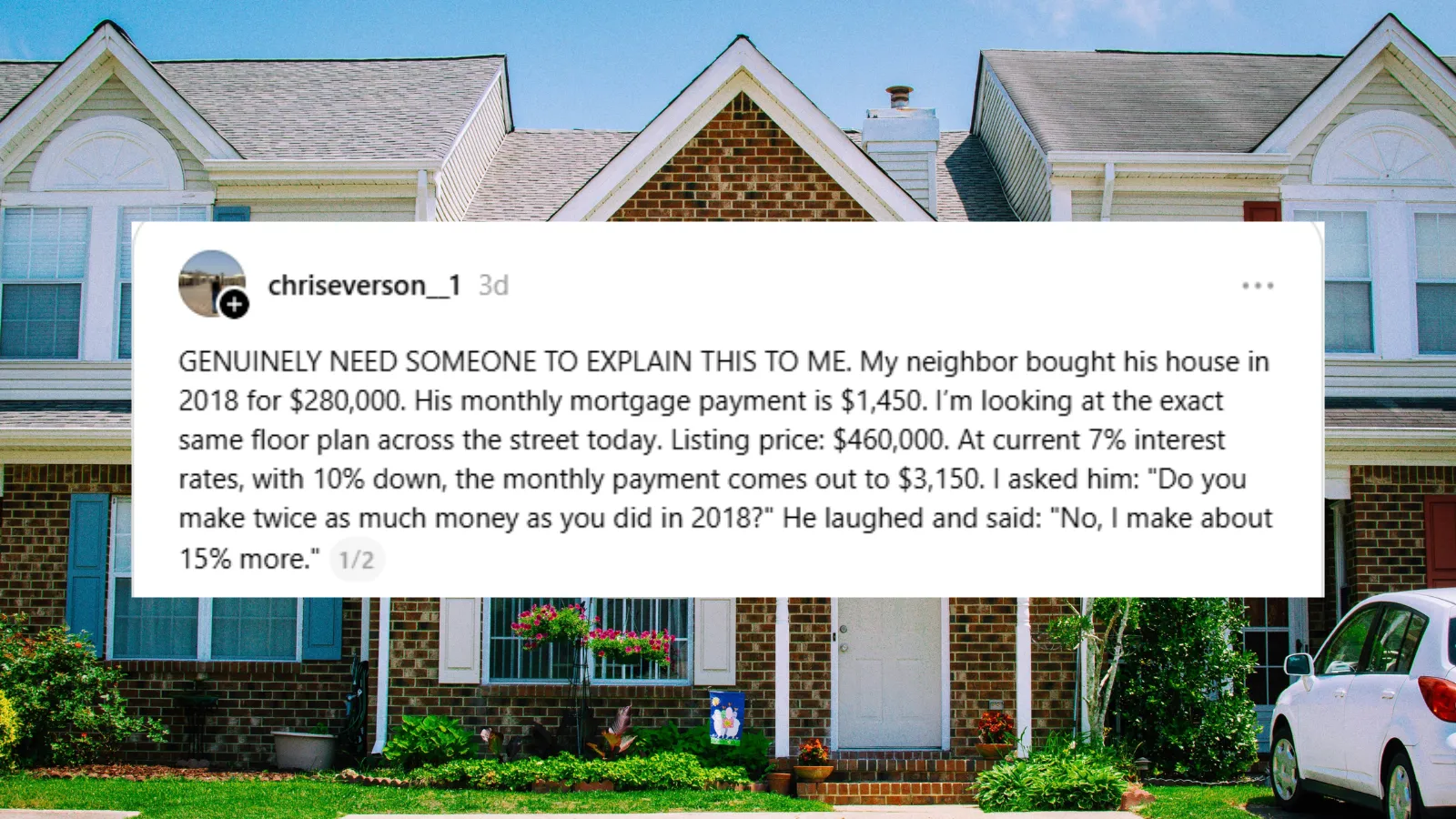
One frustrated person shared their aggravation about this on Threads, asking people to explain how home prices can keep going up if wages aren’t. “My neighbor bought his house in 2018 for $280,000,” Threads user @chriseverson__1 wrote. “His monthly mortgage payment is $1,450. I’m looking at the exact same floor plan across the street today. Listing price: $460,000.”
The post went on to explain how even with 10 percent down, the costs still seemed insurmountable, especially when compared to what his neighbor was paying. “At current 7 percent interest rates, with 10 percent down, the monthly payment comes out to $3,150,” the post continued. “I asked him, ‘Do you make twice as much money as you did in 2018?’ He laughed and said, ‘No, I make about 15 percent more.'”
Hopeful Homeowner Calls the Current Housing Market a Locked ‘Generational Gate’
View on Threads
Frustrations abounded in @chriseverson__1’s post, saying he was looking at a significantly higher mortgage payment than his neighbor (which doesn’t appear to include taxes and insurance). “I’m being quoted $1,700 more a month for the exact same square footage, exact same school district, and exact same neighborhood,” the second half of his post said. “That isn’t home appreciation. That’s a generational gate locked right in front of anyone who didn’t buy before 2020.”
People Defended the Changing Market
While a lot of people vented about the rising cost of housing, there were those who came to its defense, writing about how the market is supposed to fluctuate over time. “It’s called inflation. Yesterday’s price is no longer today’s price,” another person wrote in part.
Someone else shared the story of how they purchased their first home right around the subprime crash. “Bought my first house in 2009. Market bottomed out the next year and we were underwater on our mortgage for years,” they wrote. “Comparing one time period to another is futile. Ask someone who bought in 2006 and had to sell and move in 2010.”
What the Numbers Show
According to the Federal Reserve Bank of St. Louis, which quoted data collected from the Census Bureau’s New Residential Sales report, the average sales price of homes in the U.S. was $502,700 as of the second quarter of 2026. That average was just $371,100 during the same quarter in 2020, highlighting how massive of a jump prices have made. With Bankrate saying that average interest rates are around 7.22 percent on a 30-year fixed mortgage, as opposed to 3.19 percent like they were in July 2020, it’s no wonder that people who are trying to purchase their first homes today are feeling the pressure.
Of course, as one commenter wrote, prices and rates do change (they were 8.26 percent in May 2000). Hopefully the next shift in the market makes things more affordable.