
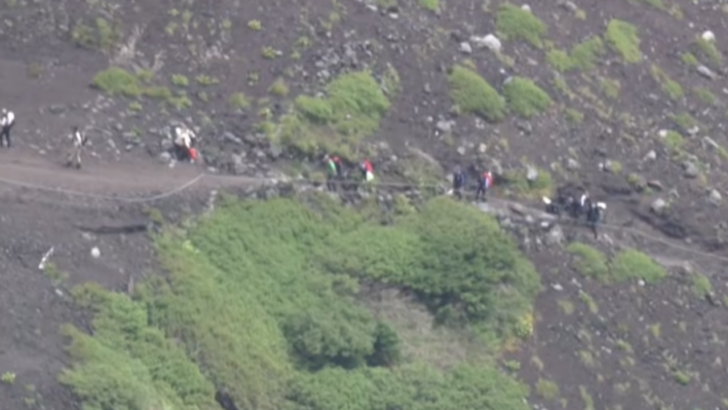
A 7-year-old boy told his father he was tired shortly after the family began climbing Mount Fuji. His father responded by telling him to wait on a bench for roughly eight hours, police said.
The boy did not ultimately spend eight hours alone. Workers at a mountain hut spotted him almost immediately and stepped in while his father continued higher on the mountain with the boy’s older brother.
The second-grader was sitting near the sixth station of Mount Fuji’s Fujinomiya Route, roughly 2,500 meters above sea level. He had climbing gear, but his backpack reportedly contained only snacks and a soft drink, and he had no money.
Police eventually ordered his father back down. The boy was unhurt, and officers gave the father a stern warning that included a particularly practical point: the mountain hut was not a daycare center.
Eight Hours
Embedded media follows; please allow a moment to load.
The family, from Nagoya, Japan, began climbing at around 7 a.m. on August 20, according to Kyodo News. The group consisted of the 7-year-old, his father, and his older brother, who was in his first year of middle school.
They reached the sixth station about 15 minutes later.
The younger boy became tired and upset. Later accounts provide some additional context for what the father was trying to do: his older son had been moving ahead of them.
The father later told police that the older boy “kept going ahead” and that the younger child had become upset, according to Shizuoka Asahi Television. He left the younger boy at the sixth station and continued up the mountain.
Workers at Hōei Sansō, a mountain hut at the sixth station, heard what sounded like an argument shortly after 7 a.m.
Akira Takai, one of the workers who later helped the boy, recalled hearing the father warn that he was really going to leave and ask whether the child planned to wait there for eight hours in the cold, according to FNN Prime Online.
Then staff noticed the boy sitting by himself on a bench with his head down.
He told them his father had instructed him to wait there for approximately eight hours.
That detail caused some confusion as the story spread internationally. Eight hours was the length of time the boy had been told to wait. It was not the amount of time he ultimately sat alone on the mountain.
The mountain hut contacted Fujinomiya Police at around 7:40 a.m. Officers reached the child about two hours later, according to Kyodo.
By then, hut workers had already taken responsibility for him.
No Daycare
Leaving the child where he was did not mean leaving him in anything resembling a city park.
The sixth station sits at an elevation of roughly 2,500 meters, and the weather on Mount Fuji can change rapidly. Fog and rain were reported around the mountain that morning.
Hut employees were particularly concerned about what could happen if the boy wandered away.
Takai told FNN there was a cliff roughly 100 meters from the area and said an unexpected accident was one reason workers decided they could not simply leave the child sitting outside.
The boy initially seemed determined to follow his father’s instructions and remain on the bench. Staff eventually persuaded him to come inside.
His supplies also looked considerably less adequate once an eight-hour wait became part of the equation.
A hut worker told Shizuoka Asahi Television that the boy had some snacks and a soft drink but no money.
Workers contacted other mountain huts and police while trying to locate his father.
Police found that he had made it to around the eighth station and told him to come back down.
The boy remained separated from his father for roughly five hours, according to TV Asahi, although much of that time was spent safely with mountain hut staff rather than alone on the bench.
When the father returned, police handed his son back to him and issued a stern warning.
Officers told him his actions could potentially run afoul of criminal law and that he needed to reconsider his conduct.
Then they clarified the role of the people who had spent the morning caring for his son:
“The mountain hut is not a daycare center.”
Police said the father appeared remorseful.
No arrest was reported.
Could It Be Criminal?
The lack of an arrest did not necessarily mean leaving a 7-year-old on the mountain was legally inconsequential.
Attorney Yasuo Sawai examined the case for Bengo4.com, a Japanese legal news site.
Sawai said the circumstances could theoretically raise an issue under Japan’s law against abandonment by a person responsible for someone’s protection.
A 7-year-old would fall within the class of people protected by the law, he explained, while a parent has a legal duty to care for a child.
Whether the father’s conduct actually met the elements of a crime would depend on details that have not been made public, including the circumstances surrounding the decision, how long the child was left, and the environment around him.
The nearby mountain hut and other climbers could also matter when assessing the danger.
Sawai said prosecution appeared unlikely in this case because workers quickly protected the boy and he suffered no injury.
That is a legal expert’s assessment, not a reported decision by prosecutors.
Too Young?
The story also produced another question: Should a 7-year-old have been climbing Mount Fuji at all?
There is no blanket rule prohibiting it.
Japan’s official Mount Fuji climbing site says whether a child can make the climb depends on physical fitness and previous hiking experience.
The site’s guidance notes that many organized climbing tours begin accepting children around the fourth grade. For children without climbing experience, it recommends first getting accustomed to hiking on smaller mountains.
That puts the 7-year-old well below the age commonly accepted by organized tours, but it does not make taking him onto Fuji inherently prohibited or automatically reckless.
Police offered a more useful rule after this incident.
When climbing as a group, Fujinomiya Police said, everyone should adjust to the person with the least physical strength and avoid becoming separated.
In other words, reaching the summit stops being the priority when one member of the group cannot continue.
Back at Six
Six days later, police returned to Hōei Sansō.
This time, nobody needed rescuing.
Fujinomiya Police presented the hut’s staff with a certificate of appreciation for protecting the child and helping officers find his father, according to Shizuoka Asahi Television.
Staff member Tamaki Watai said it had been cold and foggy that morning, which made workers worry about the boy remaining outside.
Once inside, the 7-year-old apparently settled in.
The hut makes souvenir walking sticks, and workers let him help put stickers on them while he waited to be reunited with his family.
The incident also happened during a particularly busy climbing season for police on the Fujinomiya Route.
Between July 10 and August 24, officers responded to 43 mountain emergencies on that route, nearly twice the 24 recorded during the entire previous climbing season, according to a later Shizuoka News report.
Police said they had repeatedly encountered groups in which an injured or exhausted climber became unable to continue and companions went on without them.
Fujinomiya Police Chief Yasuyuki Suzuki did not respond by telling families to keep children off Mount Fuji.
He said climbing with children can be a good experience, but groups need to move according to their least experienced and least physically capable member.
And when that person cannot keep going, police said, the group should be willing to turn around.