
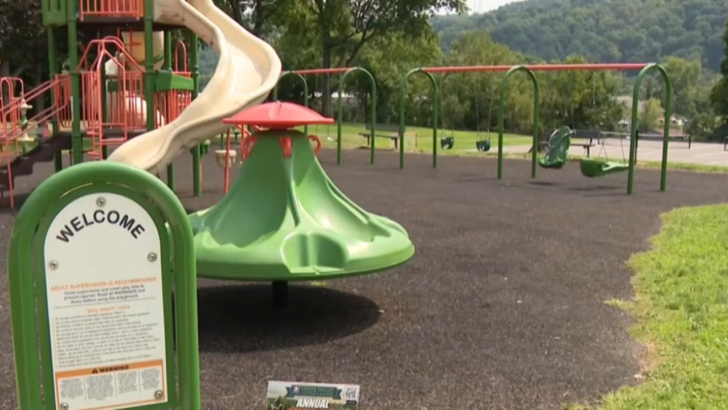
A group of children twisting a playground swing in Pennsylvania managed to produce considerably more than a dizzy ride.
The swing’s chain broke, and Springdale Borough divided the repair bill among five children it said were involved. Each child’s share came to about $59, according to the borough.
Three families paid. The charges involving their children were subsequently withdrawn.
The mother of the remaining two children, sisters ages 10 and 12, declined to pay. Their criminal mischief cases instead went before a judge, where the borough had video of what happened, a playground rule telling visitors not to twist the chains, and one problem it ultimately couldn’t overcome: proving the girls intended to break the swing.
A Trip To Court
Embedded media follows; please allow a moment to load.
The incident happened at Veterans Memorial Park in Springdale, a borough northeast of Pittsburgh.
Katie Huss told WTAE that her daughters were playing with several other children. Two children were sitting on the swing while others twisted it so they could spin and get dizzy.
Then the chains broke, sending the swing down.
Springdale Borough says surveillance footage captured the children’s conduct before and during the damage. The borough also says visitors encounter its “Play Smart Rules” when entering the park, including a specific instruction: “Do not twist chains.”
Police identified five children as being involved and divided the cost of the damage evenly among them at about $59 each.
Rather than immediately proceeding with the cases, the borough says Springdale police contacted the children’s parents or guardians about restitution.
According to the borough, three families paid their shares, and the charges involving those children were withdrawn.
Huss initially agreed to pay her family’s portion during a conversation captured on an officer’s body-worn camera, the borough says. An invoice was prepared, but Huss later declined to pay.
That left her two daughters headed for a hearing.
What Broke?
Huss wasn’t simply disputing whether her daughters had been at the playground. She questioned whether their actions constituted intentional damage to borough property and sought information about the condition of the equipment.
She told WTAE that when police approached her about paying for the repair, she asked for evidence that her daughters had intentionally broken the swing and proof that the equipment had previously been inspected.
The borough says its records show inspections had occurred and that it had no documented safety concerns, maintenance problems, previous complaints, or known conditions indicating that the swing was defective or unsafe before the incident.
That does not establish the precise mechanical condition of the chain at the moment it broke. It does mean there is no documented pre-existing defect in the information the borough says it reviewed.
And twisting a swing chain is not necessarily harmless to the equipment. Safety instructions for other swing products also warn users not to twist chains or loop them over a support because doing so may reduce their strength.
Springdale nevertheless had to establish more than the fact that the children twisted the swing and it subsequently broke.
The Missing Piece
Pennsylvania’s criminal mischief law covers several forms of property damage, including intentionally damaging another person’s real or personal property.
At the hearing, a Springdale police officer testified that the girls were “negligently not using the swing properly,” according to court transcript material reported by WTAE.
The borough argued that the children’s conduct supported the cases. Its solicitor, Craig Alexander, later said the judge acknowledged seeing the children twist the swing and cause it to break.
But causing something to break did not establish that they meant to break it.
According to the borough’s description of the ruling, the judge was unable to find beyond a reasonable doubt that the children intended for the swing to break.
The girls, therefore, were not held responsible in the criminal mischief cases.
The judge indicated that the dispute was more appropriately a civil negligence matter, according to the borough.
Still Not Finished
The case generated a considerably less technical verdict among viewers online.
Many reacting to the television report said twisting and spinning playground swings was something they remembered doing as children. Others questioned whether children ages 10 and 12 should have ended up in court over the damage at all.
Several viewers also assumed the broken chain demonstrated poor maintenance. The available evidence does not establish that: the borough says it had no documented prior problems with the swing and that its surveillance footage showed the children twisting it immediately before it broke.
The court similarly did not find that the girls had nothing to do with the damage.
Instead, the distinction that ended the cases was narrower.
The judge could see the children twisting the swing and causing it to break, according to the borough, but could not find beyond a reasonable doubt that they intended to break it.
That disposed of the criminal mischief cases.
It may not dispose of the $59 shares.
Huss told WTAE that she had been informed the borough was considering a civil lawsuit. Springdale said any decision about pursuing civil recovery would be made after consultation with its solicitor and consideration of the evidence and applicable law.