
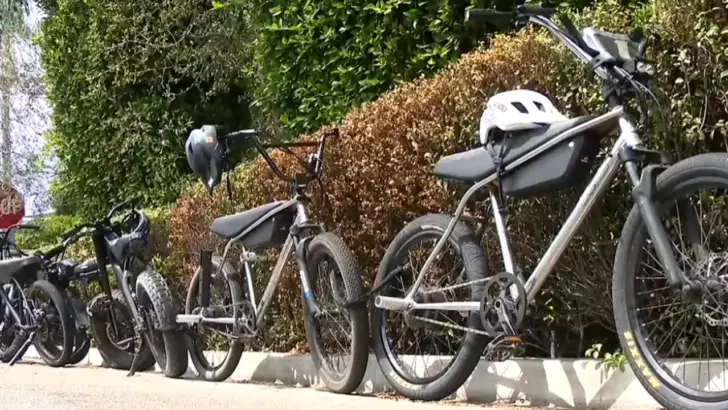
A California school district wanted electric bikes away from its younger students’ campuses. The bikes did not necessarily disappear. Some of them moved across the property line.
Students at Ensign Intermediate School in Newport Beach who continue riding e-bikes to school have been parking them on nearby public streets, and CBS Los Angeles found residents dealing with groups of as many as 20 bikes outside their homes. Some parents, meanwhile, say their children have faced confrontations and other problems after being pushed off school property.
The situation follows a new Newport-Mesa Unified School District policy prohibiting students in transitional kindergarten through eighth grade from possessing or operating e-bikes and e-motos on school property, including the campus periphery. High school students can still bring e-bikes to campus after meeting the district’s safety requirements.
The policy was intended to address safety concerns surrounding young riders. Less than two weeks into the school year, however, Newport Beach is dealing with another question: Where exactly are all those e-bikes supposed to go?
Across The Street
The district’s new bicycle and e-bike policy took effect with the 2026-27 school year. Students in TK through eighth grade cannot possess or operate e-bikes on school property or around the campus perimeter, while traditional bicycles remain permitted.
The school board approved the policy 6-1 in April after months of debate. High school students were treated differently, in part because board members recognized that older students may rely on e-bikes to reach jobs and after-school activities.
At Ensign, at least some younger riders found a straightforward workaround. They ride to the neighborhood around school and leave their e-bikes there.
Resident Janet Montgomery told CBS Los Angeles that the bikes have appeared in groups of up to 20 at a time. She said they initially blocked walkways and have interfered with residents trying to garden or move their cars.
That has created a new dispute over bikes that were previously stored on school grounds.
Two girls told the station that somebody deflated the tires on their e-bikes. Parent Tim Middleton said someone left a note on his son’s bike warning that it would be impounded if it was parked in the same location again.
Middleton said he has told his son to keep parking responsibly, avoiding red zones, keeping the bikes near the curb, and respecting the people who live nearby.
Another student’s experience shows that simply finding a public bike rack may not settle the matter.
CBS reported that a student who left an e-bike at nearby John Wayne Park received a notice from Newport Beach Public Works warning that the bike would be confiscated if it was not removed within 24 hours.
Parents Push Back
The parking dispute comes as some Ensign parents are mounting a broader challenge to the district’s policy.
Alex Williamson, whose son continues riding an e-bike to school, told CBS that he believes students are less safe parking away from campus because they are now interacting with people outside school grounds and leaving expensive bikes more vulnerable to theft.
Williamson and another Ensign parent, Sarah Middleton, went considerably further in an Aug. 27 community opinion piece published by Voice of OC, calling for the district to rescind the policy and restore e-bike access to campus racks.
The two Costa Mesa residents argued that the policy did not eliminate students’ e-bike trips. Instead, they said, it moved the parking onto public streets while adding more cars to school drop-off and pickup traffic.
They also pointed to a distinction at the center of the disagreement. The district controls its campus and bike racks, but it does not generally control what students ride on public streets before arriving at school.
Their position is not the only one among parents.
When the ban took effect, some families told CBS Los Angeles that they welcomed the change. One father said the district’s decision helped his family resist pressure to buy his daughter an e-bike, while another parent said losing the transportation option meant she expected to be late for work because she would have to drive her child through school traffic.
The disagreement was already apparent before the policy passed. Parents and students spoke against the proposal at board meetings, while supporters argued that younger riders lacked the experience needed to safely operate the increasingly popular electric bikes.
A Bigger Crackdown
Newport-Mesa’s policy did not emerge in isolation.
Orange County has been escalating its response to e-bikes and more powerful electric motorcycles following serious and sometimes fatal crashes involving young riders.
In May, the Orange County District Attorney’s Office announced a dedicated e-bike and e-motorcycle prosecution unit to review potential criminal cases involving juveniles, adults, and parents who knowingly allow children to operate illegal electric motorcycles.
District Attorney Todd Spitzer’s office said injuries involving e-bikes and e-motorcycles in Southern California had increased 430% over four years. The office has also pursued cases against parents accused of knowingly allowing children to operate electric motorcycles illegally.
Newport Beach itself has tightened the rules.
City regulations that took effect in January require e-bike riders to travel at reasonable speeds, follow traffic controls, yield when required, and use bike lanes where posted. The city specifically prohibits behavior including weaving through pedestrians, performing wheelies, riding distracted, carrying passengers on devices not designed for them, and riding without required lighting.
Violations can result in citations, fines, and possible impoundment.
The city has also specifically prohibited riding e-bikes and several similar devices on the Newport Elementary School playground during designated hours, and its municipal code allows bicycles and e-bikes left in city parks or attached to city property for 48 hours or longer to be treated as abandoned and impounded.
So the argument playing out around Ensign is taking place in a community that has already spent considerable time deciding where e-bikes can be ridden, how they can be ridden, and who should be responsible when young riders break the rules.
Now it may have to decide where students can leave them.
Finding A Spot
Newport Beach Councilmember Erik Weigand supports the school district’s e-bike ban, but he told CBS that the current parking situation may require some adjustment.
Weigand said city staff are researching ways to find a middle ground. One possibility could involve one- or two-hour parking restrictions, although he acknowledged that those restrictions could have consequences for residents as well.
There is another connection between the city and the school district: Weigand’s wife, Krista Weigand, sits on the Newport-Mesa Unified School District board and voted with the majority that approved the policy.
The lone opposing vote came from Trustee Ashley Anderson. Voice of OC reported after the April vote that Anderson had questioned whether the district was moving ahead before Newport Beach and neighboring Costa Mesa had aligned their approaches to e-bikes.
Her concern now looks particularly relevant.
The school district can keep younger students’ e-bikes off its property. Newport Beach controls the streets, parks, and other public spaces surrounding Ensign. Residents have their own expectations about what happens in front of their homes.
The students and their bikes are sitting directly in the middle of all three.