
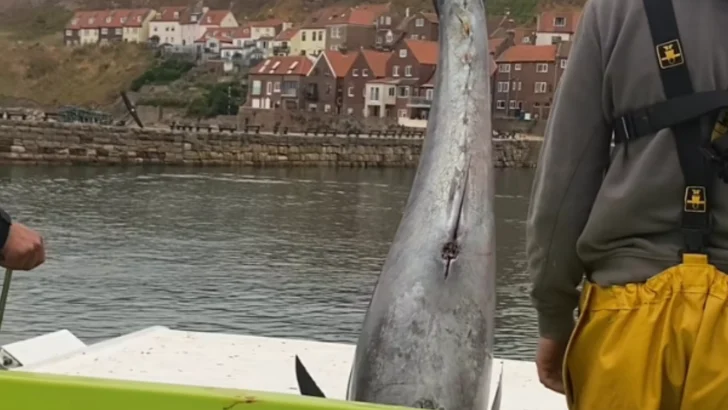
Giant Atlantic bluefin tuna have returned to the Yorkshire coast after an absence of roughly 60 years, with a fishing crew landing two of the enormous fish in two days.
On Sunday, the five-person crew of The Dominator caught a 338-kilogram, or roughly 745-pound, bluefin about 10 miles from Whitby Harbour, according to the BBC. By the next day, the crew had returned to the water—and caught another weighing more than 300 kilograms, or 661.2 pounds.
The catches come as scientists are documenting the wider return of bluefin tuna to northeast England. Researchers from the University of Exeter recently tagged five of the fish off Whitby, the first time the team has done so in the region. Footage taken by Riley Skye was shared on The Whitby Photographer Facebook page.
Bluefin were once so frequent a sight around Yorkshire that the area boasted a famous big-game fishing industry, but they disappeared from the North Sea by the 1960s amid overfishing and the depletion of herring shoals. Researchers now say their return offers an encouraging sign that decades of fisheries management have indeed made a difference.
A Giant Predator Returns To Its Old Waters
Embedded media follows. Please allow a moment for it to load.
In the 1930s, the Yorkshire coast became an international destination for anglers dreaming of big bluefin tuna, back then known as “tunny.” The University of Exeter notes that visitors included Hollywood icons such as John Wayne, Clark Gable, and Errol Flynn.
The species later suffered catastrophic declines. University of Exeter ecologist Dr. Lucy Hawkes said careful fisheries management has helped bluefin stocks recover enough for the fish to begin spreading back into waters where they historically lived.
Their presence can also provide insight into the ecosystem beneath them. Hawkes explained that bluefin are top predators that depend on healthy populations farther down the food chain, making their return a possible indicator of healthier waters.
The fish found off northeast England are particularly interesting to researchers because they are considerably larger than bluefin previously tagged farther south. Exeter scientists say they may even be genetically distinct, though more research is required to determine a point of origin.
Their Return Can Provide Even More Information For Scientists
Researchers have taken to attaching electronic tags to the returning tuna to learn where they travel. The tags record light, temperature, and depth for up to two years before detaching and transmitting data by satellite, according to the University of Exeter.
Better fisheries management appears to be an important part of the comeback. The Guardian reports that bluefin were once fished nearly to extinction in Mediterranean spawning grounds, but stronger protections have allowed populations to rebuild and even expand into former territory.
Warmer seas may also be contributing. Researchers told the Guardian that rising North Sea temperatures can affect the distribution of bluefin and their prey, including herring and sprat, although they described fisheries management as the more important factor in the recovery.
The return is being managed cautiously. For 2026, the Marine Management Organisation authorized up to 30 commercial vessels to target bluefin using rod and line, with quota limits and reporting requirements intended to keep the developing fishery sustainable.