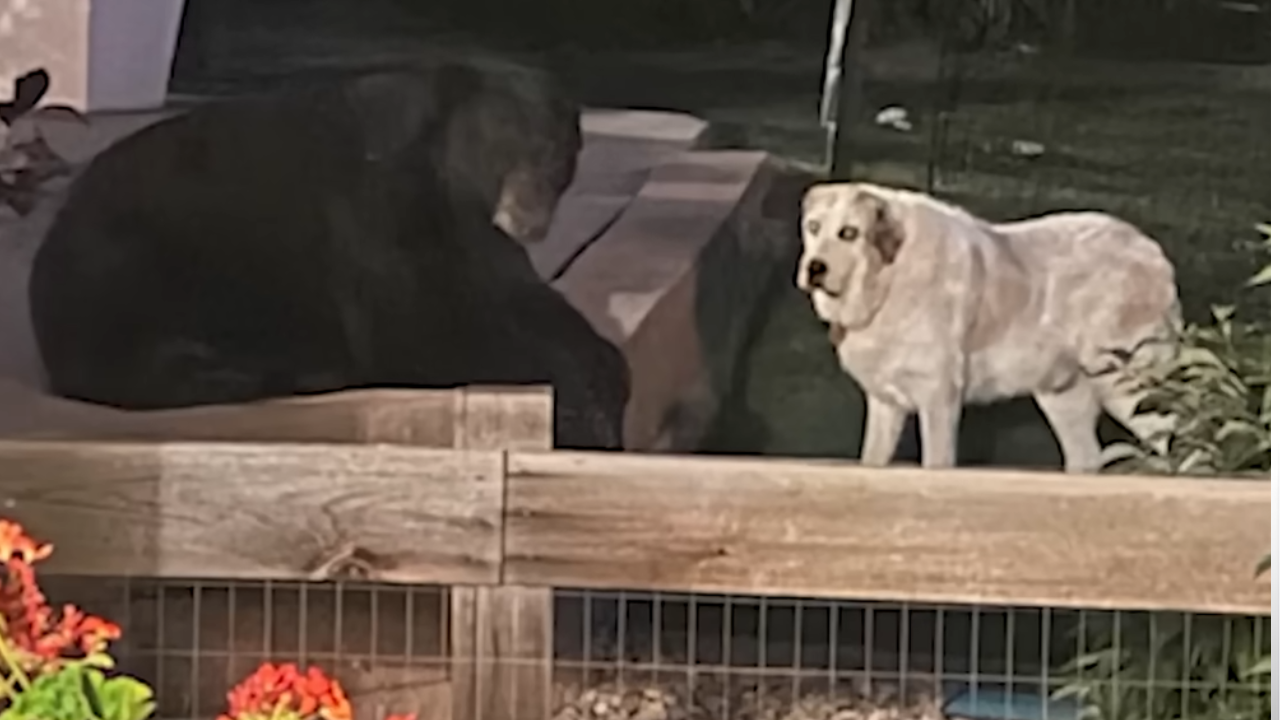
A Colorado Dog Defended His Turf From a Bear Lazily Lounging on the Patio
What would you do if you saw a bear getting close to your family dog? It might sound scary, but hear us out.
What if the bear was just hanging out and relaxing? That’s what happened to one family in Arvada, Colorado. A large black bear stretched out on their patio while their dog barked at it from a few feet away. Lucas Eads, who lives nearby, captured the encounter with a series of photos and told KXAN the bear eventually stood up and walked off down the sidewalk. Nobody was hurt, and most importantly, the dog, named Sully, was perfectly fine.
Eads said Sully was “just trying to defend his turf,” which is totally understandable. No self-respecting dog will simply allow an unfamiliar beast to encroach on their space. The bear seemed unbothered by the dog’s barking throughout its visit. It finally left the property on its own, at its own pace, after having some much-needed relaxation time at a strangers’ house.
Except the animal isn’t, however, a stranger to the entire block. Eads said the bear has turned up around the neighborhood over the past few years, and residents say it seems to be growing more comfortable around people. Arvada police reported an uptick in bear sightings this spring, concentrated west of Ward Road in Arvada and Wheat Ridge, and asked residents to call so animal management officers could respond.
The encounter fits a statewide pattern. Colorado Parks and Wildlife told KDVR on July 10 that 2026 is on pace to be a record year for bear reports, with more than 1,000 additional reports so far than at the same point last year. The agency attributes the increase to drought.
Why Colorado Is on Pace for a Record Year Attracting Bears
Joey Livingston, the Colorado Parks and Wildlife spokesman who tracks statewide bear activity, said the shortage of natural food is what makes bears start exploring around neighborhoods. Dry conditions limit the types of natural foods that bears rely on, so they end up closer to humans looking for things to eat. As a result, the agency logged 5,299 sightings and conflicts in 2025, roughly 15% above the previous six-year average, and this year’s pace is running ahead of that.
Colorado has only black bears, with an estimated 17,000 to 20,000 across the state. Most reports involve a bear trying to reach human food rather than any aggressive encounter. Unsecured garbage is the single largest driver, accounting for close to a third of all reports the agency receives.
Why a Bear Getting Comfortable Is a Real Concern
The detail that makes this encounter notable is the one residents described casually: the bear is getting comfortable. Wildlife managers call that habituation, and they treat it as the beginning of a problem rather than a charming development. Tim Kroening, a Colorado Parks and Wildlife area wildlife manager, told Denver7 that each time a bear finds food from or near people, it learns that “people equal food,” and that a bear which becomes habituated cannot be untaught. Black bears also tend to return each year to the first substantial food source they find, so a productive block stays productive in the bear’s memory.
The outcome for a habituated bear is often bad for the bear. One was shot and killed in a Douglas County neighborhood earlier this month. Arvada police have asked residents in the affected area to take down bird feeders and hummingbird feeders, secure trash cans, and avoid leaving pets outside unsupervised. Colorado Parks and Wildlife advises anyone who spots a bear before it notices them to stand still and back away quietly, and anyone approached by one to hold their ground, wave their arms, and yell until it leaves, with bear spray the most effective deterrent if a bear turns threatening.