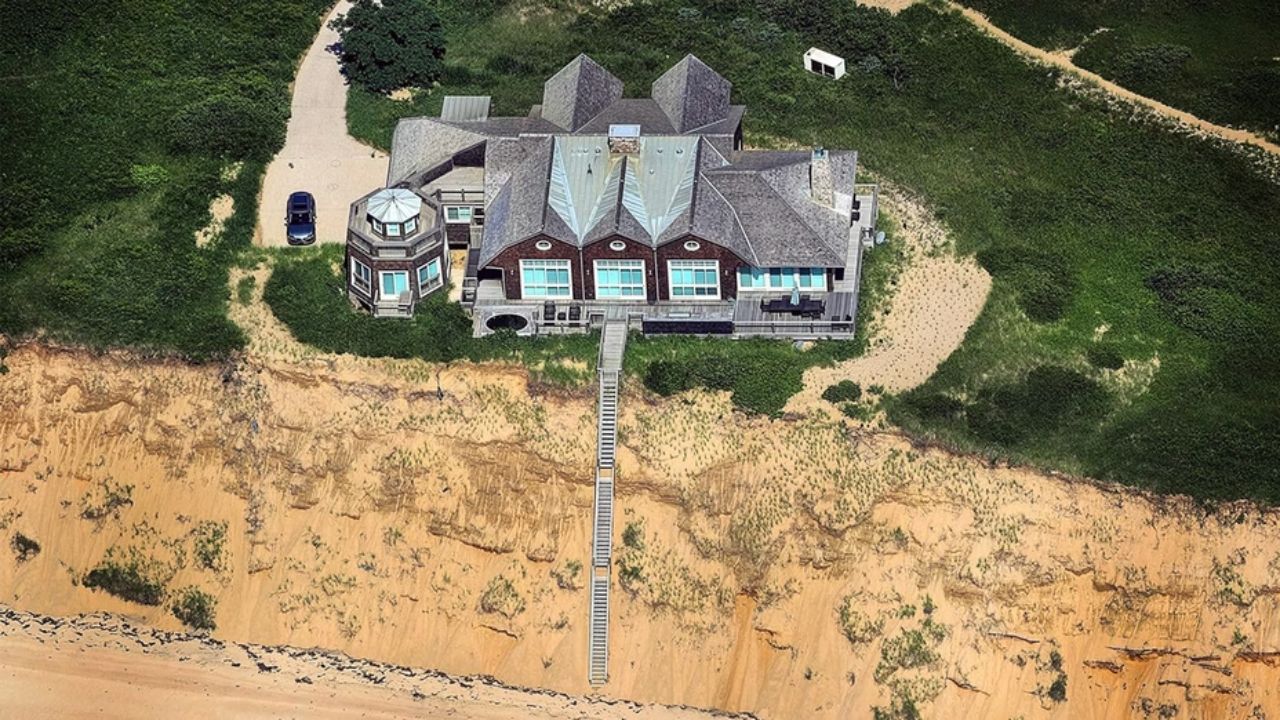
A Lawyer Bought a $5.5 Million Cape Cod House on a Crumbling Cliff. Now He’s Suing the Bank
A Wellfleet, Massachusetts, homeowner is suing JPMorgan Chase to void the $3.85 million mortgage he took out on a Cape Cod house that was torn down last year. It was taken down just before erosion could pull it into the sea. John G. Bonomi Jr., a retired New York attorney, argues that he wasn’t actually mentally competent enough to take out the loan to purchase it, and that the bank should not have made it, according to the Boston Globe.
The house at 1440 Chequessett Neck Road was contested long before Bonomi bought it. Mark and Barbara Blasch built the home, more than 5,000 square feet, in 2010 on a coastal bank inside the Cape Cod National Seashore. The National Park Service objected at the time, and the home became known locally as the Blasch House. Its erosion problem and court fights drew years of local coverage until Bonomi bought it in November 2021 for $5.5 million.
Bonomi listed the house for roughly a million dollars less than he paid and didn’t sell it, and he later blamed the town for refusing to let him build a stone revetment to hold back the cliff. Crews demolished the house in February 2025 as it seemed more likely to collapse straight into the bay. Wellfleet re-assessed the land that was left, which Bonomi’s attorney says he still owns, at $385,000 around January 2025.
Bonomi filed the suit in October 2025 in the United States District Court for the Southern District of New York. He’s now looking to void the mortgage and entire note for $3.85 million, along with interest, damages, and attorney’s fees, and he’s also requested a jury trial. In response, Chase first asked to have the case dismissed, then answered the complaint in May, denying all allegations and saying it would leave Bonomi to prove his claims.
What Bonomi’s Lawsuit Argues
The suit says Bonomi has bipolar disorder and was “acting under an uncontrollable manic psychosis” when he made the purchase. He added that irrational risk-taking, impulsive behavior, and reckless spending are known symptoms of the condition. The filing also alleges that Chase was aware, or avoided acknowledging, that he wasn’t competent enough to enter the agreement at the time, and that no rational person would have bought the property at the full asking price.
The appraisal is one of the disputed points. Bonomi’s attorney, Thomas Moore, told the Globe that the bank says it showed Bonomi the appraisals, and that Bonomi never saw them. Wellfleet assessed the property at more than $4.38 million in 2021, the year of the purchase. Moore said he had nothing to add beyond the filings and didn’t know of any case where a similar argument was used to void a mortgage.
What Legal and Medical Experts Say
New York does have precedent for voiding a contract on mental capacity grounds. In the 1969 case Ortelere v. Teachers’ Retirement Board of the City of New York, an appellate court held that a contract may be rescinded when the person who signed it was laboring under a mental defect that kept them from acting reasonably, and the other party knew of that defect. Ethan Leib, a law professor at Fordham Law School, told the Globe that Bonomi faces a difficult burden of proof, questioning how the bank would have known he was in a manic phase and noting the $5.5 million price against the town’s $4.38 million assessment in a speculative market.
Annie Harper, an assistant professor of psychiatry at Yale University who studies finances and mental health, said there is no question that a person with bipolar disorder in a manic state could spend an extraordinary sum. She told the Globe the situation is more complicated than that, and that the larger question is how to build systems that limit the financial damage when it happens.