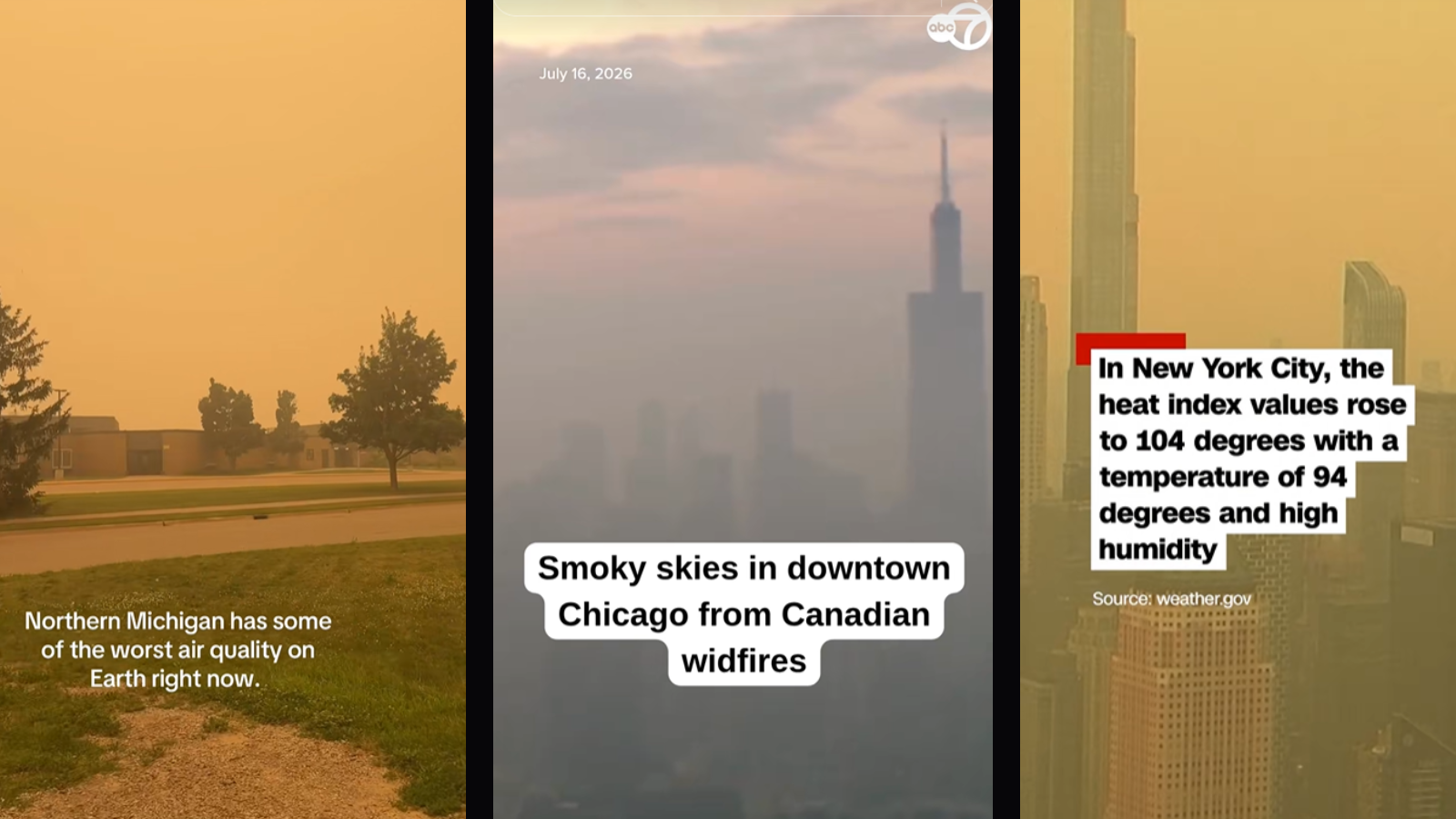
20 States Are Now Reporting Air Quality Issues From Canada’s Wildfires
If you live in the U.S. and have noticed an orange tint in the air, you’re not alone. That’s because the smoke from the massive Canadian wildfires has drifted down to the U.S., blanketing large parts of the country in a smoky haze. According to The Guardian, 20 states were experiencing the effects of the smoke as of July 16. That amounts to millions of Americans who are under a variety of different types of air quality alerts, with local municipalities warning some residents in hard-hit areas to stay indoors.
The smoke is being sent down to the states thanks to more than 180 active wildfires, with no end in sight. That’s created a dangerous situation for Americans, especially those in some of the hardest-hit cities in the north. In fact, one U.S. state was said to have the worst air quality in the world at the moment, earning it an unwanted title that came along with warnings for residents.
Other cities are making masks available to those who can’t stay inside, trying to ease the effects of pollutants.
Keep reading to find out if your state is being affected by Canada’s wildfire smoke, and if so, when you can expect some relief.
Canada’s Wildfire Smoke Reaches the U.S.
@nbcnewsLarge swaths of the Northeast were in the red “unhealthy” air quality index category before dawn Thursday, a prognosticator of conditions to come as smoke from Canadian wildfires hits its thickest point over the New York area. The smoke is expected to linger at least through Friday.♬ original sound – nbcnews
Nearly two dozen states are experiencing the effects of the Canadian wildfires, according to NBC News. This is causing “unhealthy” air quality indexes for many places before the sun came up on Thursday. The dangerous smoke can be seen in areas from the northwest to the northeast, with New York reporting heavy smoke in certain areas of the state.
The Guardian says that air quality alerts were issued for areas of Wisconsin, Michigan, Washington D.C., Maryland, Virginia, Colorado, West Virginia, Delaware, Ohio, Indiana, Illinois, Pennsylvania, New Hampshire, New Jersey, Rhode Island, Massachusetts, New York, Connecticut, Vermont, Minnesota, and North Carolina.
Those in certain areas like Pennsylvania, New York, and New Jersey were put under high alerts as the air in the region became “unhealthy,” according to the publication. Meanwhile, people in parts of Illinois and Michigan were told that the air was “very unhealthy,” and those in parts of Wisconsin and Minnesota were told that their air was “hazardous.”
Meanwhile, Detroit residents were informed that their air reached extreme pollutant levels on Thursday, as IQAir determined that it had the worst air quality in the world.
Wildfire Smoke Will Remain for the Rest of the Week
A midday July 16 report from IQAir says that conditions will begin to improve by the weekend, thanks to changing wind patterns, but that people living in the affected areas could continue to see smoky conditions for the next 10 days. That is, of course, if the wildfires remain active in Canada and some northern U.S. states.
Additionally, a heat dome that has settled over the central U.S. could cause timelines to shift, since it is keeping smoke trapped at lower elevations and forcing it southeastward.
Vulnerable populations who are worried about possible smoke exposure should check their local weather stations to find out exactly what conditions are like where they live, and when they can expect relief.