Farmers Almanac Shares First Snowfall Predictions
Snow bunnies across the country are likely dreaming of the first time their local meteorologist has snow listed on the forecast. Depending on where you live, that dream could already be a reality or still months away.
For those who can’t wait to find out when those flakes are expected to fall, there’s the Farmers’ Almanac. The annual publication offers up a ton of information each year, including long-range weather forecasts that farmers have been using to plan their growing seasons for generations.
As such, many people look to the almanac to get a sense of what upcoming seasons will be like, especially when it comes to winter snowfall. And as luck would have it, the Farmers’ Almanac just shared a reminder about when the typical first snowfall takes place across the country.
According to the September update from the almanac, some places aren’t expected to see any of the white stuff this upcoming winter, while others have already experienced their first snowfall.
The Farmers’ Almanac Shared a Color-Coded Map of the Country
View this post on Instagram
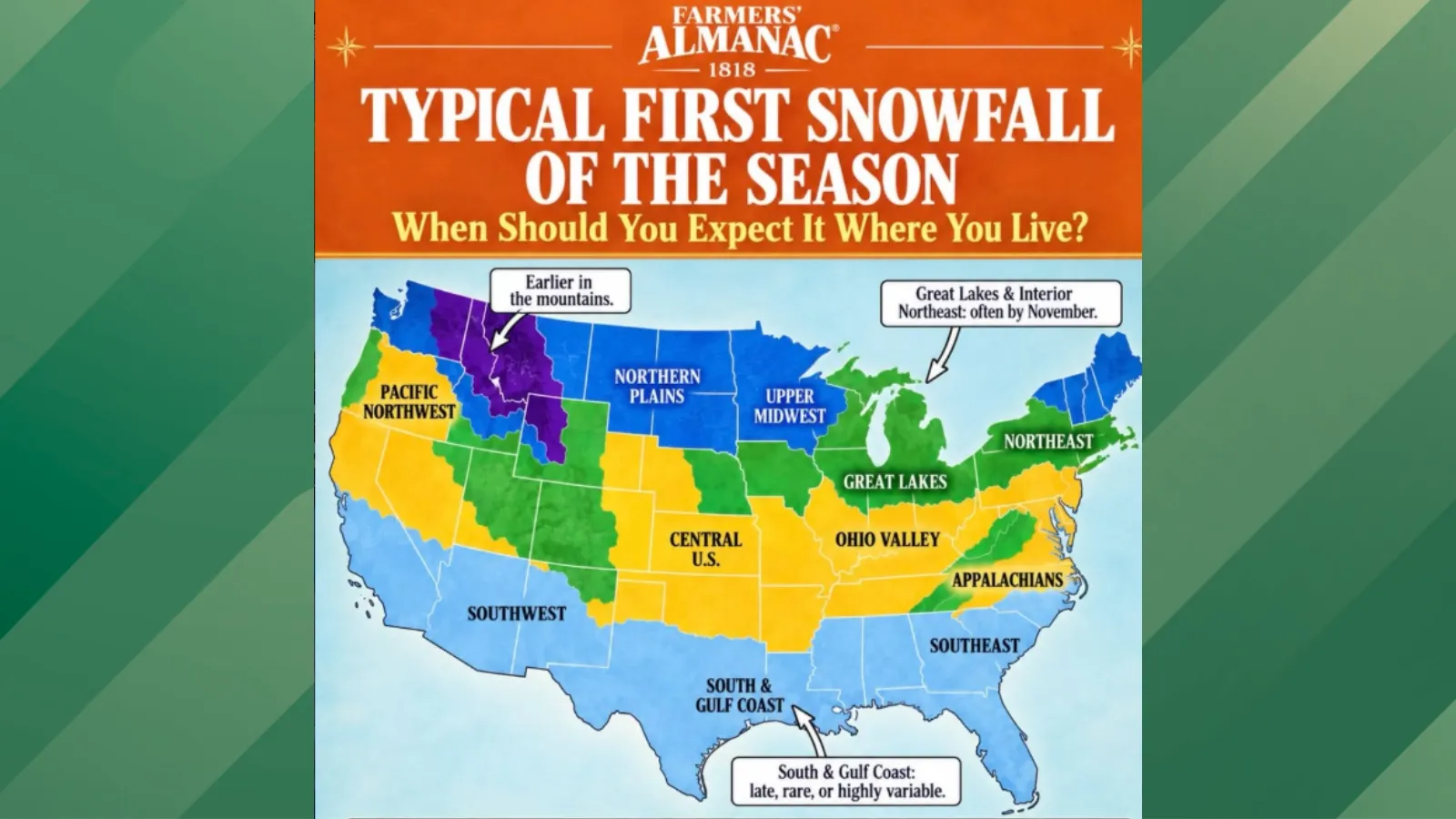
Farmers’ Almanac shared its expectations about when snow will begin to fall in different regions of the country via its Instagram page. The publication posted a colorful graphic explaining its predictions, which was later accompanied by an article breaking down some of the nuance—for example, the almanac is referencing the appearance of the first flakes and not the date when snow will begin to accumulate.
So who gets to see the flakes appear first? According to the almanac, that honor belongs to the higher elevations in the northwest part of the country, which typically start seeing snow in August or September. And it looks like that prediction was spot on since AccuWeather says that Mt. Bachelor in Oregon saw some snow falling at the start of September.
October and November Will Bring the First Flakes to Other Areas
Snow may be right around the corner for areas like the Northern Plains, the Upper Midwest, and New England, all of which typically see flakes arrive in October. Then the Great Lakes, the Northeast, and higher elevations in the Central Rockies all follow in November.
Late November through December will be when the Central Plains, Mid-Atlantic interior, the Ohio Valley, and the lower-elevation areas of the Northwest finally get in on the fun.
Bringing up the rear will be those areas that either have very rare snowfall or no snow at all, which includes the Deep South, Gulf Coast, desert Southwest lowlands, the lower Southeast, and Florida.
People in the Comments Disagreed With the Snowfall Map
Those who live in the areas mentioned were quick to call out inaccuracies in the expectations. “Colorado too late, Washington too early except for the high Cascades,” one person wrote.
“Way off for middle Tennessee,” another person added. “Late November and early December are usually golf days, sitting outside in late afternoon on the patio… basic sweater weather.”
“Arkansas and southern Missouri don’t get the first snow until usually late December or January. Looking at the comments, this map is wrong in a lot of places,” a third person shared.
While there was a lot of chatter about how the map was wrong in a lot of areas, it’s not exactly the almanac’s fault. According to Climate Central, winter is the “fastest-warming” time of year for most of the U.S., which leads to less snow in many regions. As the world’s temperature continues to rise, snowfall patterns could continue to change, making it harder to accurately predict when winter precipitation will actually begin, which could be what is happening with this map.
That being said, it seems like it’s already right about places like Oregon, so everyone may just need to wait and see how this winter actually shakes out before deciding whether the almanac got it right or not.